What Is the Pink Cloud in Recovery? Signs, Risks, and How to Stay Grounded
The pink cloud, also called pink cloud syndrome, is a phase of natural euphoria that many people experience in the early weeks of addiction recovery, once acute withdrawal has ended, and the brain begins to rebalance. It is a real, neurologically driven experience that is genuinely motivating, but it also carries a well-documented risk: the same overconfidence that makes it feel like the hard work is already done compels people to disengage from treatment exactly when they need it most.
Key Highlights
- Rooted in brain chemistry: The pink cloud phase is driven by the brain's dopamine system, beginning to normalize after chronic substance use suppressed it. The relief from the removal of substances can temporarily produce feelings of intense well-being.
- Relapse risk is highest in early recovery: According to the National Institute on Drug Abuse (NIDA), 40% to 60% of people with substance use disorders relapse, with risk concentrated in the first months of sobriety, the same window as the pink cloud.
- Not universal: Not everyone experiences the pink cloud. Some people feel it for a few days; others for several months. A minority skip it entirely. The experience depends on the individual, their substance history, and their mental health baseline.
- PAWS follows the pink cloud: Post-Acute Withdrawal Syndrome (PAWS) — a secondary phase of emotional flatness, fatigue, and cognitive difficulty — affects an estimated 70% to 90% of people in recovery and begins as the euphoria fades (Hazelden Betty Ford, 2025).
- The euphoria is used strategically: When recognized early, the pink cloud is an ideal window to build therapy relationships, establish support networks, and develop relapse prevention habits while motivation is high.
What Is the Pink Cloud in Addiction Recovery?
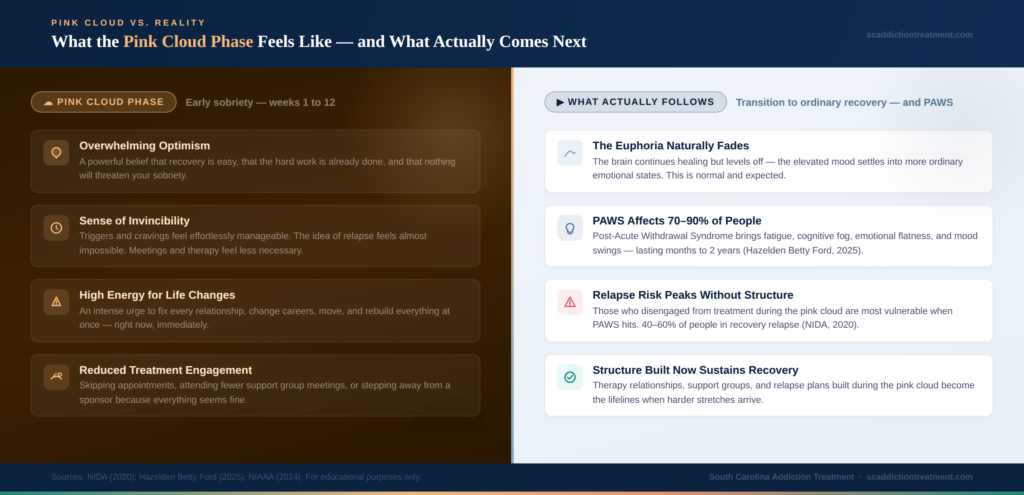
The pink cloud makes recovery feel effortless — but the emotional work of building lasting sobriety begins when it fades.
The pink cloud is a phase of recovery characterized by feelings of euphoria, optimism, and emotional relief that typically emerges once the physical symptoms of detox and acute withdrawal have subsided.
The term originated in the Alcoholics Anonymous (AA) community as informal recovery slang, describing the sensation of feeling so good and so certain of sobriety that the ongoing demands of recovery no longer seem necessary.
The experience tends to begin within days to a few weeks of stopping substance use and last anywhere from a few days to several months. While the feelings it generates are genuine, they do not reflect a permanent new baseline; they reflect a brain in the early stages of chemical rebalancing, and they will naturally fluctuate.
Not every person in recovery will experience the pink cloud. Some people move directly from the physical discomfort of withdrawal into the more emotionally demanding work of early sobriety. Others cycle in and out of the euphoric phase multiple times throughout their recovery journey.
What Causes the Pink Cloud?
The pink cloud is caused by the brain's dopamine system, the network of brain circuits involved in motivation, reward, and the experience of pleasure, beginning to rebalance after chronic substance use.
Addictive substances work by flooding the brain's reward center (the nucleus accumbens) with dopamine, far beyond what any natural activity produces. Over time, the brain compensates by reducing the number of dopamine receptors and lowering its baseline production of the neurotransmitter (National Institute on Alcohol Abuse and Alcoholism [NIAAA], 2024).
During active addiction, this leaves the brain in a state of chronic reward deficiency; nothing feels as good as it once did without the substance. When the substance is removed, and the brain begins to rebalance, there is a window in which dopamine activity temporarily overshoots before settling. This is the neurological basis for the elevated mood many people feel in early recovery.
Research on methamphetamine recovery has shown that dopamine transporter levels in the brain's reward center approach near-normal levels after approximately 14 months of abstinence, with meaningful improvements already visible at one month (Recovery Research Institute, 2025). This recovery is not linear, which is why the emotional states in early sobriety can feel so unpredictable.
What Are the Signs of Pink Cloud Syndrome?
The signs of the pink cloud syndrome are as follows:
Common Signs
- Overwhelming optimism: A strong belief that recovery will be easy and that the hardest work is already behind you
- Sense of invincibility: A feeling that relapse is no longer a realistic possibility, or that triggers and cravings can be effortlessly managed
- Intense relief and emotional release: After months or years of emotional numbing from substance use, feeling things again — hope, joy, love — feels overwhelming in the best sense
- High motivation for life changes: An energized desire to fix relationships, start new habits, change careers, and pursue large goals simultaneously
- Reduced engagement with recovery support: Skipping therapy appointments, attending fewer meetings, or stepping back from a sponsor because things feel so manageable
- Underestimating future challenges: Difficulty imagining that the stresses of daily life will ever pose a real risk to sobriety
Is the Pink Cloud a Good or Bad Thing?
The pink cloud is neither purely positive nor purely dangerous — it depends entirely on how it is used. On its own, the euphoria of early sobriety is a natural and welcome shift after the pain and chaos of active addiction.
The Benefits
The pink cloud phase gives people in early recovery access to high levels of motivation, emotional openness, and willingness to change. This makes it one of the best windows to begin building evidence-based recovery habits — attending therapy consistently, establishing structured routines, connecting with a sponsor or support group, and repairing important relationships.
These habits, built during a high-motivation period, can carry people through harder stretches ahead.
The Risks
The primary danger of the pink cloud is overconfidence. The National Institute on Drug Abuse reports that between 40% and 60% of people with substance use disorders relapse, with the highest risk in the first few months of sobriety, which coincides directly with the pink cloud window (NIDA, 2020). People who believe their addiction is fully resolved stop attending therapy, skip meetings, or place themselves in high-risk situations without adequate preparation.
A secondary risk is the emotional crash that follows when the pink cloud fades. Without realistic expectations and a stable support system in place, the shift from euphoria to the more ordinary emotional landscape of recovery — or the onset of PAWS — feels like a catastrophic drop, triggering hopelessness and increasing the urge to use.
How Does the Pink Cloud Compare to PAWS?
Pink cloud compares to PAWS as a temporary state of early-recovery euphoria followed by a prolonged, more challenging phase of neurological stabilization.
Post-Acute Withdrawal Syndrome (PAWS) is a secondary phase of recovery in which the brain's ongoing healing process produces mood disturbances, cognitive difficulties, and emotional instability.
PAWS is not a sign that something has gone wrong; it is a sign that the brain is still healing. It feels like a dramatic contrast to the euphoria of the pink cloud, and it is a leading contributor to relapse if not properly understood and supported. Hazelden Betty Ford notes that PAWS symptoms last anywhere from a few months to two years, depending on the individual and the substance (Hazelden Betty Ford, 2025).
| Pink Cloud | Post-Acute Withdrawal Syndrome (PAWS) | |
|---|---|---|
| When it occurs | Days to weeks after acute withdrawal ends | Weeks to months into recovery, after pink cloud fades |
| How it feels | Euphoric, optimistic, energized, confident | Foggy, fatigued, anxious, emotionally flat, irritable |
| How long it lasts | Days to a few months (varies by individual) | A few months to up to 2 years |
| Primary risk | Overconfidence leads to skipping treatment | Emotional pain and cravings increase relapse risk |
| What helps | Use the energy to build support systems | Therapy, structured programs, peer support, self-care |
Understanding both the pink cloud and PAWS as phases of brain recovery — rather than reflections of personal strength or weakness — is a core part of dual diagnosis treatment, which addresses both the substance use disorder and the mental health changes that accompany recovery.
How Long Does the Pink Cloud Last?
The duration of the pink cloud is highly individual. For some people, it lasts a few days. For others, it persists for several months. There is no consistent timeline, and neither a shorter nor longer experience is inherently better.
What matters most is what comes next. Some people experience the pink cloud in a single sustained period; others feel it come and go intermittently throughout the early months of recovery. In either case, the return of more ordinary emotional states — and sometimes the arrival of PAWS — is a predictable part of the process that is planned for rather than feared.
This is one of the reasons structured addiction treatment programs teach people to monitor their emotional states throughout recovery, not just during the most difficult phases. Recognizing the pink cloud for what it is — a real but temporary neurological event — removes the element of surprise when it fades.
How Can You Make the Most of the Pink Cloud Phase?
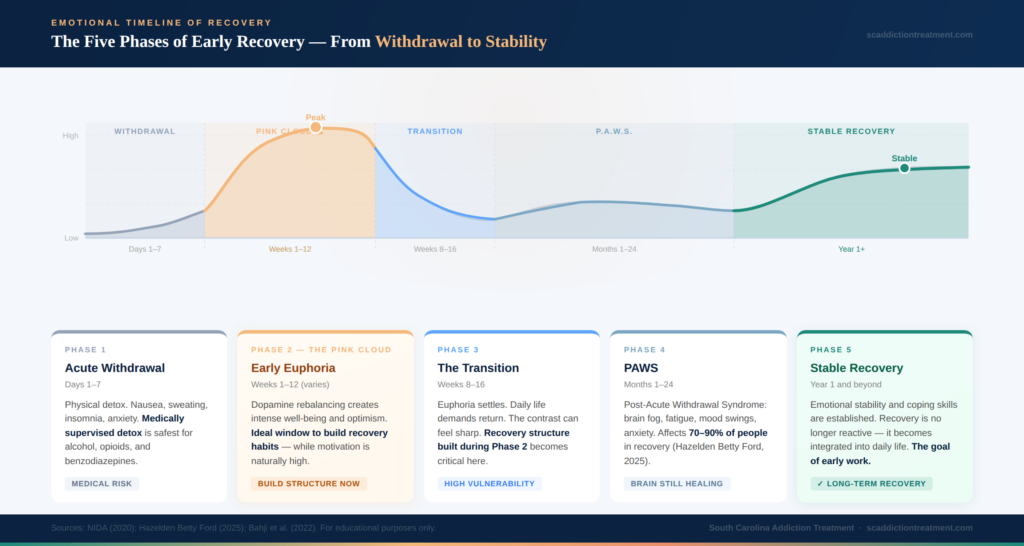
Early recovery involves a sequence of emotional phases. Understanding the pink cloud and PAWS helps people stay grounded through both the highs and the lows.
You can make the most of the pink cloud phase as given below:
- Build your recovery structure now: Use the high-motivation period to establish consistent therapy attendance, meeting schedules, and check-ins with a sponsor or recovery coach. These structures become lifelines when motivation drops.
- Set realistic expectations: Learning about the typical emotional arc of recovery — including the pink cloud, the transition to more neutral states, and the possibility of PAWS — reduces the risk of being caught off guard. Many treatment programs include psychoeducation (structured education about the recovery process) as a core component.
- Avoid major impulsive decisions: The euphoria of the pink cloud makes large life changes feel urgent and obvious — quitting a job, ending a relationship, moving cities. Wherever possible, hold off on irreversible decisions until you have more time in recovery and a clearer, more stable emotional baseline.
- Journal your current state: Writing down how recovery feels right now gives you something concrete to return to during harder stretches. Many people in recovery find that reading their own early reflections is a powerful reminder that the good feelings are real — and that they will come back.
- Stay honest with your support system: Tell your therapist, sponsor, or peers in recovery that you are feeling this way. A good support network will celebrate your progress while also gently keeping you grounded about the work ahead.
- Prepare a relapse prevention plan: Use the clarity and energy of the pink cloud phase to identify your personal triggers, map out high-risk situations, and create a concrete action plan for how you will respond when they arise.
The pink cloud, properly understood, is one of the most useful phases of early recovery. The key is redirecting the elevated energy and motivation it provides toward actions that will support sobriety long after the euphoria is gone.
Frequently Asked Questions
Is the pink cloud the same as a relapse warning sign?
Not exactly. The pink cloud itself is not a relapse, but overconfidence during the phase is a documented relapse risk. The concern is not the euphoria itself — it is the way that euphoria leads people to disengage from treatment before they have built a stable enough foundation to sustain recovery on their own.
Does everyone in recovery experience the pink cloud?
No. The pink cloud is common but not universal. Some people in early recovery experience it clearly; others move through a more muted or unpredictable emotional landscape. The absence of a pink cloud phase does not mean something is wrong with someone's recovery.
What happens when the pink cloud ends?
For most people, the pink cloud phase gradually fades as the demands of everyday life return, and the initial relief of sobriety settles into something more ordinary. Some people experience an emotional dip — or the onset of PAWS symptoms — when this happens. Having a strong support system, a committed therapy relationship, and an honest comprehension of what to expect lowers the risk of relapse during this transition.
If the emotional shift feels unmanageable, it is important to speak with a treatment professional rather than trying to push through it alone. Structured outpatient programs are specifically designed to offer ongoing support through these kinds of transitions.
Can the pink cloud happen more than once?
Yes. Some people in recovery report experiencing the euphoric feelings associated with the pink cloud multiple times, following meaningful milestones, such as completing a treatment program, reaching a sobriety anniversary, or resolving a major life problem. Each recurrence carries the same dynamic: the elevation is real, the risk of overconfidence is present, and the principles of staying grounded apply equally.
How is the pink cloud different from bipolar disorder or hypomania?
The pink cloud superficially resembles the elevated mood, energy, and reduced need for sleep that characterize hypomania in bipolar disorder. The key distinction is timing and context: the pink cloud emerges specifically in the early weeks of sobriety following substance cessation, subsides naturally, and is not accompanied by the more extreme behavioral changes (impulsivity, rapid speech, grandiose behavior) that characterize a hypomanic episode.
Because the two overlap — and because substance use unmask underlying mood disorders — anyone experiencing unusually intense or prolonged euphoria in recovery must discuss it with a mental health professional. Dual diagnosis treatment evaluates and treats both conditions at once.
Summary
The pink cloud is a natural phase of early recovery marked by euphoria and optimism — a genuine signal that the brain is beginning to heal, but one that requires recognition and structure to prevent it from becoming a path toward relapse.
If you or someone you love is navigating early recovery and wants to build a foundation that holds through the highs and the harder stretches, South Carolina Addiction Treatment offers individualized detox, residential, and outpatient programs designed to support every phase of recovery — from the first days of sobriety through long-term relapse prevention. Explore admissions today to learn more.
References
Hazelden Betty Ford Foundation. (2025). Post-acute withdrawal syndrome (PAWS). https://www.hazeldenbettyford.org/articles/post-acute-withdrawal-syndrome
National Institute on Alcohol Abuse and Alcoholism. (2024). Neuroscience: The brain in addiction and recovery. National Institutes of Health. https://www.niaaa.nih.gov/health-professionals-communities/core-resource-on-alcohol/neuroscience-brain-addiction-and-recovery
National Institute on Drug Abuse. (2020). Principles of drug addiction treatment: A research-based guide (3rd ed.). National Institutes of Health. https://nida.nih.gov/download/675/principles-drug-addiction-treatment-research-based-guide-third-edition.pdf
Recovery Research Institute. (2025). The brain in recovery. https://www.recoveryanswers.org/recovery-101/brain-in-recovery/
Substance Abuse and Mental Health Services Administration. (2024). Key substance use and mental health indicators in the United States: Results from the 2023 national survey on drug use and health (HHS Publication No. PEP24-07-021, NSDUH Series H-59). Center for Behavioral Health Statistics and Quality. https://www.samhsa.gov/data/data-we-collect/nsduh-national-survey-drug-use-and-health/national-releases/2023
Bahji, A., Crockford, D., & El-Guebaly, N. (2022). Neurobiology and symptomatology of post-acute alcohol withdrawal: A mixed-studies systematic review. Journal of Studies on Alcohol and Drugs, 83(1), 29–39. https://pmc.ncbi.nlm.nih.gov/articles/PMC9798382/
Haskell, B. R. (2021). Identification and evidence-based treatment of post-acute withdrawal syndrome. The Nurse Practitioner, 46(11), 25–33. https://doi.org/10.1097/01.NPR.0000795802.71196.3e
Kitzinger, R. H., Jr., Gardner, J. A., Moran, M., Celkos, C., Fasano, N., Linares, E., Muthee, J., & Royzner, G. (2023). Habits and routines of adults in early recovery from substance use disorder: Clinical and research implications from a mixed methodology exploratory study. Substance Abuse: Research and Treatment, 17(1). https://pmc.ncbi.nlm.nih.gov/articles/PMC9926005/