How Long Does Trazodone Stay in Your System?
Trazodone stays in your system for 1 to 3 days after the last dose in most healthy adults. The drug carries a terminal elimination half-life of 5 to 13 hours, and the liver clears it through the enzyme CYP3A4.
How fast trazodone leaves the body depends on liver function, age, dose, and length of use. Detection windows shift by test type: blood reads recent use within 72 hours, while hair holds traces up to 90 days.
Key Takeaways
- Trazodone carries a terminal elimination half-life of 5 to 13 hours. The body needs roughly 5.5 half-lives to clear a drug, which places full elimination near 1 to 3 days for most adults.
- The liver enzyme CYP3A4 converts trazodone into meta-chlorophenylpiperazine (mCPP), the only active metabolite, which urine byproduct screens detect after the parent drug clears.
- Per research in the Journal of Analytical Toxicology, mCPP cross-reacts with amphetamine and MDMA immunoassays, producing false positives that require confirmation by gas chromatography-mass spectrometry (GC-MS).
- The U.S. Food and Drug Administration does not classify trazodone as a controlled substance, so standard workplace panels do not screen for it directly.
How long does trazodone stay in your system?
Trazodone stays in your system for 1 to 3 days after the final dose in most healthy adults. Older adults and people with liver impairment retain it 50 to 70 hours. The timeline below tracks the drug from first dose through full clearance.
- 30 to 60 minutes: Trazodone absorbs into the bloodstream after an oral dose taken on an empty stomach. Food delays the peak.
- 1 to 2 hours: Trazodone reaches peak blood concentration, the point where its sedating and mood effects feel strongest.
- 2 to 4 hours: The active metabolite mCPP reaches its own peak as CYP3A4 converts the parent drug.
- 5 to 13 hours: One half-life passes and blood levels drop by half. Effects of an immediate-release tablet fade over 5 to 9 hours.
- 1 to 3 days: Roughly 5.5 half-lives pass and the body clears nearly all active trazodone for the average adult.
- 50 to 70 hours and beyond: Older adults and people with liver impairment retain the drug longer, and byproduct traces persist in hair for up to 90 days.
How Does Trazodone Work in the Body?
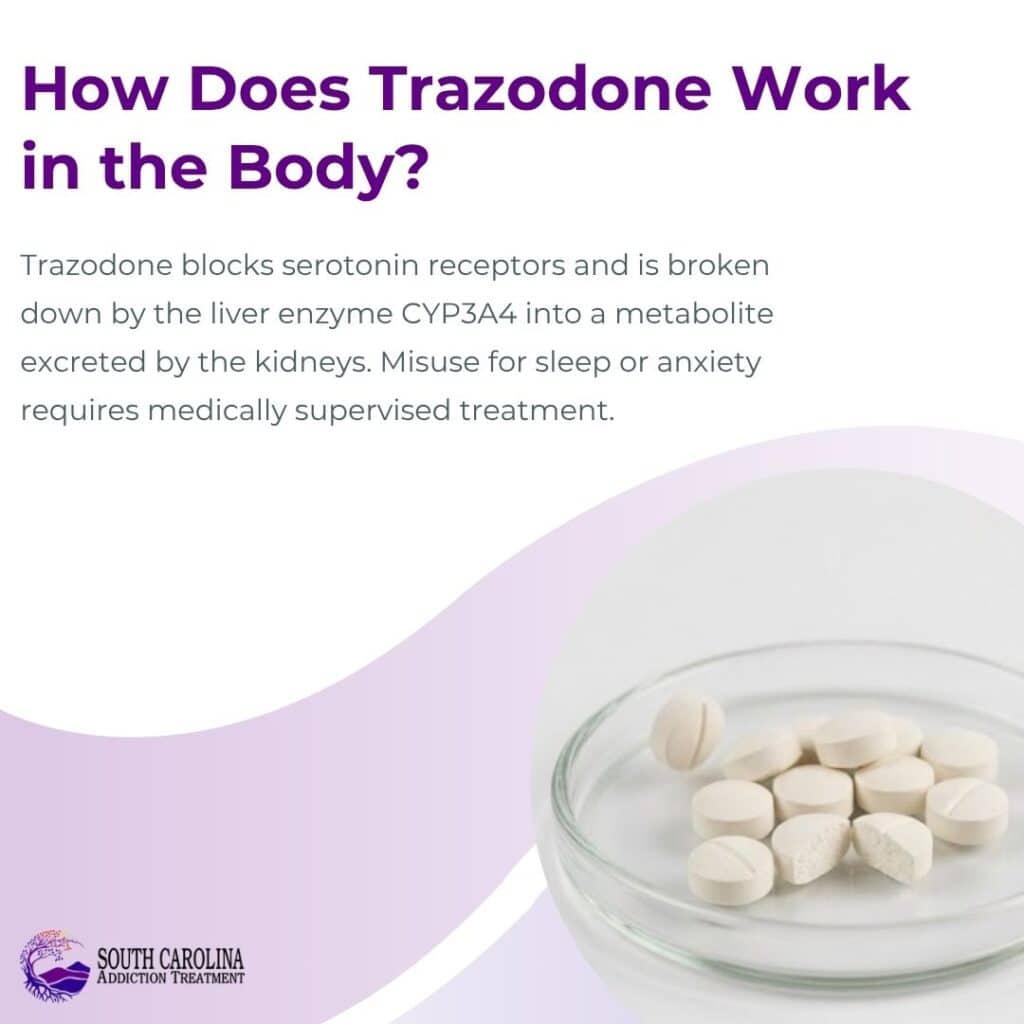
Trazodone is a prescription antidepressant in the serotonin antagonist and reuptake inhibitor (SARI) class. It blocks the 5-HT2A serotonin receptor and weakly slows serotonin reuptake.
The liver enzyme CYP3A4 converts trazodone into mCPP, its only active metabolite a process Rotzinger and colleagues confirmed in 1998, which is why CYP3A4 inhibitors slow trazodone clearance. The kidneys then excrete these byproducts through urine.
Some people misuse trazodone outside of medical guidance to self-treat insomnia or anxiety, which can disrupt this normal clearance process. Medically supervised prescription drug addiction treatment manages that pattern under clinical oversight.
How does trazodone leave the body?
Trazodone follows biphasic elimination, clearing in two phases: a fast early drop within about 1 hour, then a slower removal phase lasting 10 to 12 hours. The kidneys excrete the byproducts, so urine carries most of the drug out.
This two-phase exit is why urine byproduct traces outlast the parent drug. The active drug clears within 1 to 3 days, yet mCPP registers in sensitive urine testing longer.
How long is trazodone detectable by each drug test type?
Trazodone detection depends on which sample a test analyzes, since each method measures the drug for a different window. Blood detects use within 72 hours, urine within 1 to 3 days, and hair up to 90 days. The table compares all four methods.
| Test Type | Detection Window | Notes |
|---|---|---|
| Blood | 24 to 72 hours | Used in medical or legal settings to confirm recent use. |
| Saliva | 1 to 2 days | Uncommon for trazodone; practical only shortly after a dose. |
| Urine | 1 to 3 days for the parent drug; mCPP registers longer | Most common screen, though standard panels do not target trazodone. |
| Hair | Up to 90 days | Longest window; reserved for use history rather than routine screening. |
Blood testing confirms recent use, while a hair follicle test reflects exposure for up to 90 days after the drug stops working. Most routine screens do not list trazodone, so detection requires a test that specifically targets it.
What factors affect how long trazodone stays in your system?
Liver function, kidney function, age, dose, and body composition determine how long trazodone stays in your system. These factors trace back to how fast CYP3A4 metabolizes the drug and how quickly the kidneys clear the byproducts.
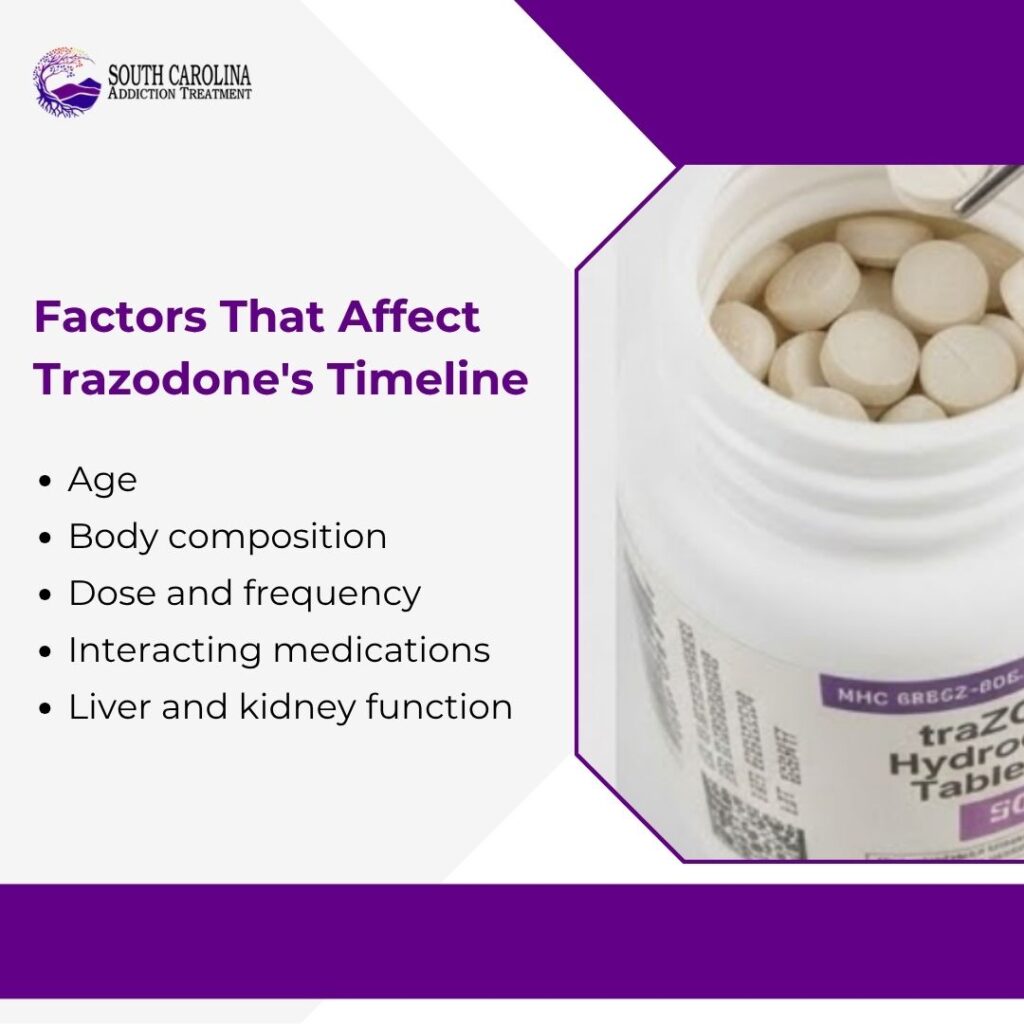
- Liver and kidney function: Reduced liver capacity slows CYP3A4 conversion of trazodone, and weaker kidney filtration delays removal of byproducts through urine.
- Age: Adults over 65 metabolize trazodone slower, which extends retention to 50 to 70 hours versus the faster clearance in younger adults.
- Dose and frequency: Doses above 100 mg or repeated daily dosing build trazodone up faster than the body removes it, lengthening total clearance.
- Body composition: Higher body fat percentage stores fat-soluble compounds longer, which slows how quickly the drug exits.
- Interacting medications: CYP3A4 inhibitors such as ketoconazole raise trazodone levels, while inducers such as carbamazepine lower them and speed clearance.
Genetic differences in liver enzymes sort people into fast or slow metabolizers, which shifts clearance times. People who combine trazodone with alcohol process the drug slower and face heightened sedation.
Can trazodone cause a false positive on a drug test?
Trazodone causes false positives on drug tests because its metabolite mCPP cross-reacts with amphetamine, MDMA, and LSD immunoassays. This interference is a documented and clinically significant cause of incorrect screen results. Reasons why false positives happen include:
- Amphetamine cross-reactivity: The mCPP byproduct cross-reacts with the Amphetamines II immunoassay, producing a false amphetamine result with no stimulant use.
- MDMA and LSD interference: Research in the Journal of Analytical Toxicology documents mCPP cross-reacting with MDMA (ecstasy) and LSD immunoassays.
- Dose-related risk: Doses above 100 mg raise mCPP concentration, which increases the likelihood of a false-positive screen.
Confirmatory testing with gas chromatography-mass spectrometry (GC-MS) separates trazodone byproducts from true stimulant use. Anyone taking trazodone should disclose it before a screen, the same caution that applies when asking how long adderall stays in your system before overlapping results.
How do trazodone and SSRIs differ in action and detection?
Trazodone and SSRIs both raise serotonin, but they differ in receptor action and elimination speed. Trazodone blocks the 5-HT2A receptor with a 5 to 13 hour half-life, while SSRIs primarily slow reuptake and clear over 1 to 6 days. The table compares both classes.
| Feature | Trazodone (SARI) | SSRIs (sertraline, fluoxetine) |
|---|---|---|
| Drug class | Serotonin antagonist and reuptake inhibitor | Selective serotonin reuptake inhibitor |
| Main action | Blocks 5-HT2A receptor, weakly slows reuptake | Primarily slows serotonin reuptake |
| Half-life | 5 to 13 hours | 26 hours (sertraline) to 4 to 6 days (fluoxetine) |
| False positive | mCPP triggers amphetamine and MDMA screens | Rare cross-reactivity on standard panels |
Fluoxetine carries a half-life of 4 to 6 days, far longer than trazodone, so it lingers longer after the last dose. Both medications appear in treatment for depression and addiction when mood and substance use overlap.
Treatment for Trazodone misuse at South Carolina Addiction Treatment
Trazodone misuse is treated through medically supervised tapering paired with cognitive behavioral therapy. Trazodone is not a controlled substance and carries low addiction potential, yet abruptly stopping it after long use triggers discontinuation symptoms such as rebound insomnia and anxiety.
South Carolina Addiction Treatment (SCAT) provides medically supervised detox and residential care in Simpsonville, South Carolina, within Greenville County. SCAT begins with detox under medical supervision, the safest setting for clearing trazodone alongside other substances.
Medical Director Dr. Dimitrova, a board-certified psychiatrist, oversees this phase, with licensed nurses available 24 hours a day. This phase then moves clients from medical stabilization into residential clinical work. The CARF-accredited, family-owned facility caps capacity at 16 beds and staffs a 5-to-6 clinician ratio for close attention.
Frequently Asked Questions
How long does it take for trazodone to wear off so I can drive?
The sedating effects of an immediate-release trazodone tablet fade within 5 to 9 hours, though grogginess lingers into the next morning for some people. Avoid driving until the drowsiness fully lifts and you know how the medication affects you.
Will drinking water flush trazodone out of your system faster?
Drinking water does not speed how fast the liver breaks down trazodone, since CYP3A4 enzyme activity controls clearance. Staying hydrated supports kidney function but does not shorten the drug's half-life.
Can you get addicted to trazodone?
Trazodone carries low addiction potential and is not a controlled substance, so physical addiction is uncommon. Some people develop psychological reliance for sleep, and stopping suddenly after long use triggers discontinuation symptoms.
Is it safe to drink alcohol while trazodone is still in your system?
Combining alcohol with trazodone deepens sedation and slows breathing, which raises the risk of dangerous drowsiness. Because trazodone stays active for 1 to 3 days, avoid alcohol throughout that window.
References
- Shin, J. J., & Saadabadi, A. (2024). Trazodone. StatPearls. National Center for Biotechnology Information. NIA
- National Library of Medicine. (2024). Trazodone: MedlinePlus drug information. National Institutes of Health. medilineplus
- Substance Abuse and Mental Health Services Administration. (2023). Drug testing resources. SAMHSA.
- Rotzinger, S., Fang, J., & Baker, G. B. (1998). Trazodone is metabolized to m-chlorophenylpiperazine by CYP3A4 from human sources. Drug Metabolism and Disposition, 26(6), 572-575.
- Saletu-Zyhlarz, G. M., et al. (2002). Trazodone pharmacology and clinical use in major depressive disorder. International Clinical Psychopharmacology.