What Is Laced Weed? Signs, Risks, and Dangers
Laced weed is marijuana mixed or sprayed with another substance, such as fentanyl, PCP, or synthetic cannabinoids, without the buyer's knowledge. Lacing occurs almost entirely in the illicit market, where no testing verifies a product's contents. The hidden additive, not the cannabis itself, creates the danger.
The South Carolina Department of Public Health recorded 2,157 drug overdose deaths in the state in 2023 and identifies fentanyl as the leading driver, frequently mixed into other drugs without the user's knowledge. That contamination pattern makes unregulated cannabis a documented safety concern statewide.
Identifying what marijuana gets laced with, recognizing the warning signs, and distinguishing an overdose from a bad high protects against a fatal exposure.
Key Takeaways
- Lacing is an illicit-market problem because state-regulated dispensary products undergo mandatory testing for additives and contaminants while unregulated sources carry the full contamination risk.
- Fentanyl is the deadliest additive and the South Carolina Department of Public Health reports that 2 milligrams, an amount that fits on a pencil tip, can be fatal.
- Xylazine now appears in the South Carolina supply, a veterinary sedative the South Carolina Department of Public Health labels "tranq" that resists naloxone reversal.
- Fentanyl test strips are legal in South Carolina, after a 2023 state law removed them from the drug-paraphernalia definition, establishing them as lawful detection tools.
What Is Laced Weed?
Laced weed is cannabis containing a foreign substance added intentionally or transferred accidentally during illicit handling. The additive can be another drug, a bulking filler, or a chemical that alters the product's weight, appearance, or psychoactive strength. The term "laced" applies to any drug mixed with a second substance the buyer did not expect.
Dealers lace products sold by weight to raise profit, and they sometimes add a potent drug to intensify effects. The illicit market enforces no quality control, so a buyer cannot verify what a given batch holds.
Street names mark specific combinations. Marijuana mixed with PCP circulates as "wet," "fry," "dusted," and "super weed." These terms identify a known additive, though most laced products carry no warning at all.
Why Do People Lace Weed With Other Substances?
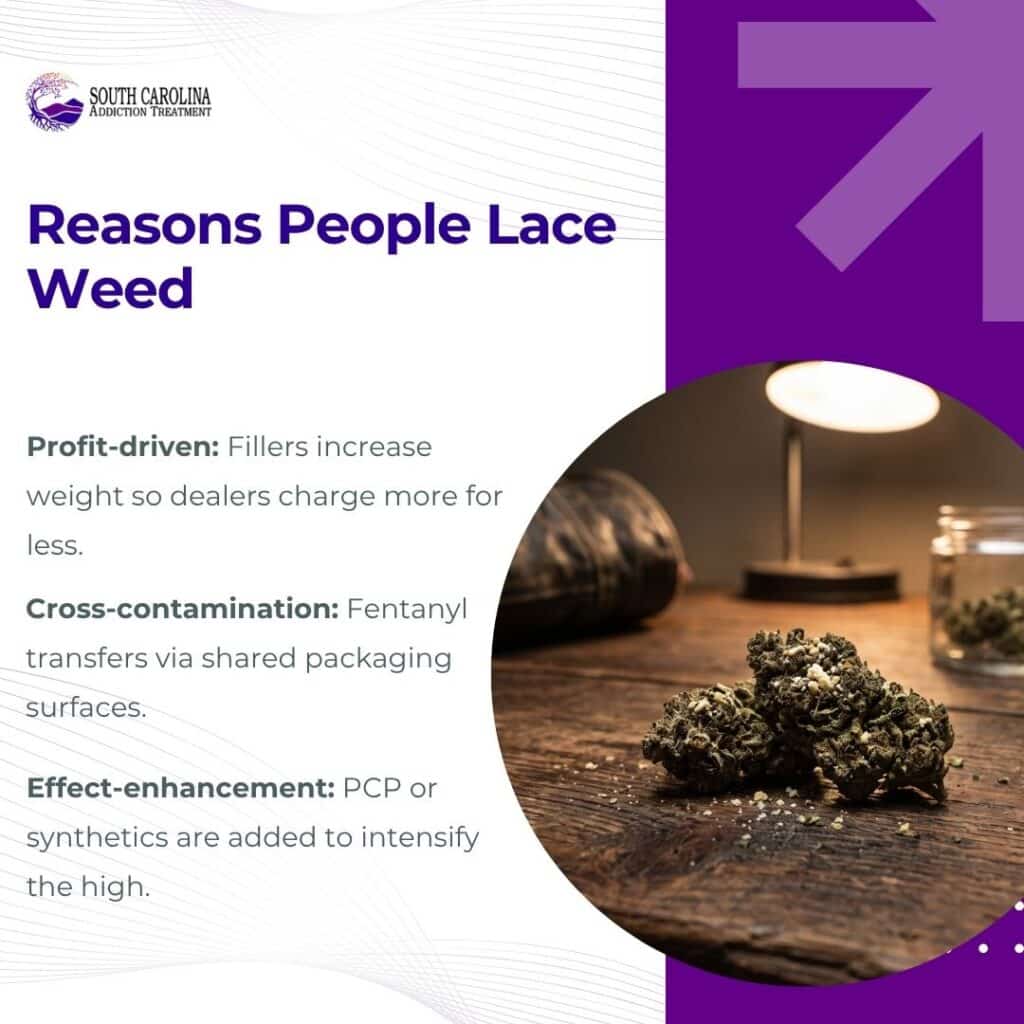
People lace weed for profit, contamination, and effect enhancement. Profit drives most intentional adulteration, accidental cross-contamination accounts for most fentanyl exposure, and deliberate opioid lacing is rare because adding an expensive drug to a cheaper one defeats a dealer's financial logic.
- Profit-driven lacing increases product weight. Dealers add inert fillers, heavy metals, plant material, and household substances that raise the weight of a product sold by the gram, letting a seller charge more for less actual cannabis. This motive drives most intentional adulteration of marijuana.
- Cross-contamination transfers trace fentanyl. Microscopic fentanyl residue moves to cannabis flower when dealers package multiple drugs on shared surfaces and equipment, delivering a contaminated product even when no one intended to lace it. This pathway, not deliberate poisoning, explains most fentanyl-in-weed reports.
- Effect-enhancement lacing alters the high. Dealers add a psychoactive drug PCP, a dissociative, or synthetic cannabinoids to strengthen and distort marijuana's effects, producing a more powerful product that commands a higher price among buyers seeking a stronger high.
What Is Weed Most Commonly Laced With?
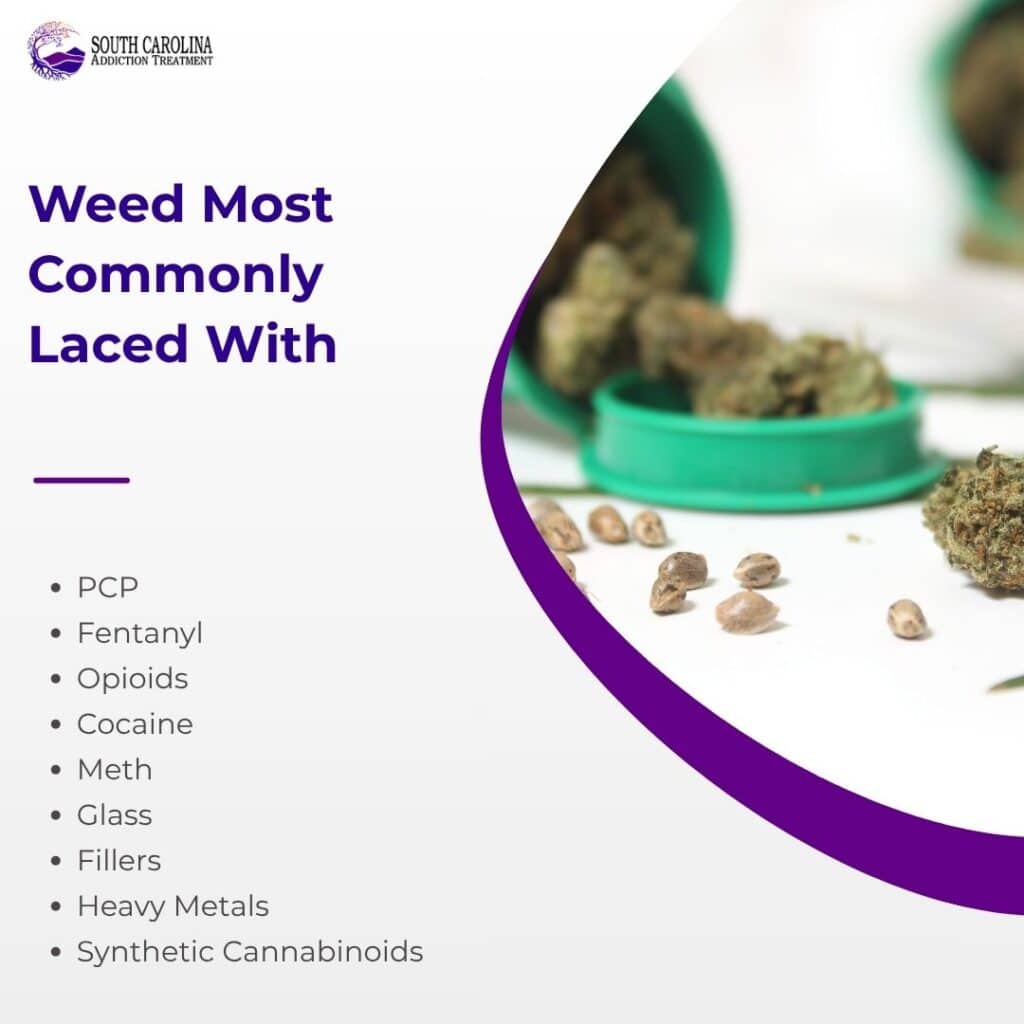
Weed is most commonly laced with 6 substance categories: fentanyl, PCP, synthetic cannabinoids, opioids including xylazine, stimulants such as cocaine and methamphetamine, and physical fillers like heavy metals or glass. Each additive produces a distinct danger profile defined below.
Fentanyl Causes Fatal Respiratory Depression
Fentanyl is a synthetic opioid up to 100 times stronger than morphine, and it suppresses breathing at microscopic doses. A 2-milligram exposure stops respiration in a person with no opioid tolerance, which makes fentanyl-laced weed the deadliest contamination scenario.
Synthetic Cannabinoids Mimic and Exceed THC
Synthetic cannabinoids, sold as K2 or Spice, are lab-made chemicals sprayed onto plant material to imitate THC. These compounds bind the same receptors as THC but activate them far more powerfully, generating severe anxiety, vomiting, seizures, and elevated blood pressure. Sellers pass off sprayed plant material as natural cannabis.
PCP Triggers Dissociation and Aggression
Phencyclidine (PCP) is a dissociative drug that disrupts perception and produces confusion, hallucinations, and aggression. PCP-laced marijuana, sold as "wet" or "fry," generates effects far stronger than cannabis alone and precipitates seizures and dangerous behavior.
Other Opioids and Xylazine Deepen Sedation
Heroin and xylazine add opioid and sedative effects that slow breathing and heart rate. Xylazine, a veterinary tranquilizer the South Carolina Department of Public Health flags as "tranq," resists naloxone reversal and deepens sedation when combined with fentanyl, compounding overdose risk across the state's drug supply.
Cocaine and Methamphetamine Add Stimulant Strain
Cocaine and methamphetamine introduce stimulant effects that clash with cannabis sedation. This combination elevates heart rate and blood pressure, producing agitation, paranoia, and cardiovascular strain that a marijuana user does not anticipate from the plant alone.
Heavy Metals, Glass, and Fillers Add Weight
Non-drug fillers add weight and false quality to a product. Lead and other heavy metals, ground glass, and substances like laundry detergent or formaldehyde appear in adulterated batches, posing risks that range from heavy-metal poisoning to respiratory injury when smoked.
How Can Someone Tell If Weed Is Laced?
No method reliably confirms laced weed by sight or smell, because the deadliest additives like fentanyl are invisible and odorless. Physical and sensory clues raise suspicion, but their absence never guarantees a safe product. The 4 most common warning signs follow.
- Unusual appearance or residue: The product shows discoloration, a chemical sheen, crystalline coating, white powder, or visible foreign particles absent from natural cannabis.
- Chemical or solvent odor: The marijuana smells like fuel, cleaning product, or harsh chemicals, or carries almost no plant odor at all.
- Disproportionate effects: A small amount produces effects far stronger, stranger, or faster than the person's typical marijuana experience.
- Reactions out of character: The person develops sudden dizziness, confusion, a racing or irregular heartbeat, or difficulty breathing shortly after use.
Fentanyl leaves no visible or smellable trace, so a clean appearance never confirms safety. A laboratory test or a fentanyl test strip remains the only reliable way to detect specific contaminants.
What Are the Signs and Dangers of Laced Weed?
Laced weed produces dangers ranging from intense anxiety to fatal overdose, depending on the additive. The effects sort into 3 tiers: common reactions, severe medical emergencies, and long-term consequences that outlast a single exposure.
Common Signs of Laced Weed
- Unexpected intensity: The high feels far stronger or more disorienting than usual, signaling that an additive amplifies the effect.
- Nausea and vomiting: The person experiences stomach upset, vomiting, or diarrhea that ordinary marijuana use does not cause.
- Heart and blood pressure changes: A spike or drop in heart rate or blood pressure follows use, pointing to a stimulant or depressant additive.
- Disorientation: The person feels detached from reality, confused, or unusually drowsy beyond a normal cannabis effect.
Severe Effects Laced Weed
Severe effects signal a possible overdose and require an immediate 911 call.
- Slowed or stopped breathing: Breathing turns shallow, irregular, or absent, the hallmark of an opioid overdose from fentanyl-laced weed.
- Blue or gray lips and fingertips: Skin and lips turn bluish or gray from oxygen deprivation, a clear overdose emergency.
- Unresponsiveness: The person cannot be woken, goes limp, or fails to respond to voice or touch.
- Seizures: The person convulses, a danger tied to PCP and synthetic cannabinoid contamination.
Long-Term Risks Laced Weed
- Dependence on a hidden drug: Repeated exposure to fentanyl or other opioids in laced weed produces physical dependence the person never intended to develop.
- Neurological damage: Formaldehyde and heavy-metal additives cause lasting cognitive and neurological harm across repeated use.
- Persistent psychiatric effects: Synthetic cannabinoids and PCP trigger lasting paranoia, anxiety, and psychosis.
How Does Laced Weed Differ From a Bad High?
A bad high produces frightening but self-limiting anxiety, while a laced-weed overdose suppresses breathing and consciousness and demands emergency care. The decisive difference is breathing: a bad high leaves it fast and rhythmic, while an opioid overdose slows or stops it.
| Sign | Bad High (Green Out) | Laced-Weed Overdose |
|---|---|---|
| Breathing | Fast and rhythmic | Slow, shallow, or stopped |
| Consciousness | Anxious but responsive | Unresponsive or limp |
| Lips and skin | Normal color | Blue or gray |
| Heart rate | Racing | Slowed (opioids) or erratic (stimulants) |
| Resolution | Eases within hours | Worsens without intervention |
A "green out" describes the panic, racing heart, and dizziness of excess THC, and it resolves on its own with rest. An overdose does not improve with time and requires naloxone and emergency response.
How Can Someone Reduce the Risk of Laced Weed?
The most effective protection is avoiding the illicit market entirely, followed by fentanyl test strips and naloxone access for anyone who still uses unregulated products. South Carolina law now supports both harm-reduction tools directly. The 4 primary safeguards follow.
- Source from regulated outlets: State-licensed dispensary products undergo mandatory testing for additives, contaminants, and potency, eliminating most lacing risk that unregulated sources carry.
- Test with fentanyl strips: A 2023 South Carolina law removed rapid fentanyl test strips from the drug-paraphernalia definition, establishing them as legal tools that detect fentanyl in a dissolved sample before use.
- Carry naloxone: Naloxone reverses an opioid overdose when administered quickly, and the South Carolina Department of Public Health distributes free kits across the state.
- Avoid using alone: Using with another person present means someone can call 911 and administer naloxone when breathing slows or stops.
Naloxone works only against opioids, so it cannot reverse PCP, stimulant, or synthetic-cannabinoid reactions.
Treatment for Cannabis Use Disorder at South Carolina Addiction Treatment
Treatment for cannabis use disorder starting with medical detox when opioids are involved. Care combines supervised withdrawal, behavioral therapy, and screening for co-occurring conditions. Medical detox manages withdrawal when a person develops opioid dependence through fentanyl-laced weed.
A clinical team monitors vital signs and treats symptoms under physician oversight, making detox the first stage for anyone exposed to opioid contamination. Care combines behavioral therapy, and screening for co-occurring conditions.
South Carolina Addiction Treatment delivers substance use disorder care at its Simpsonville facility in Greenville County. The CARF-accredited center treats addiction across all substances through its SCAT2Track program, led by Medical Director Dr. Dimitrova, a board-certified psychiatrist. SCAT operates as South Carolina's only family-owned and operated addiction treatment facility, capped at 16 beds.
The small census lets staff complete the 4 core assessments within 24 hours consistently and supports individual attention, with 2 core counselors dividing the client roster across the program.
Frequently Asked Questions
What does "wet" or "fry" weed mean?
"Wet" and "fry" are street names for marijuana dipped in or laced with PCP, sometimes alongside embalming fluid. The names mark a specific dissociative additive that produces effects far stronger and more dangerous than cannabis alone.
Can laced weed be identified by appearance alone?
No. Visual inspection cannot detect fentanyl, which stays invisible and odorless in the amounts that cause harm. A clean appearance never confirms safety, and only a laboratory test or fentanyl test strip detects specific contaminants.
Is laced weed addictive?
Laced weed creates dependence on the hidden additive, especially when that additive is an opioid like fentanyl. A person develops physical dependence on a substance consumed without knowledge of its presence.
What should someone do after smoking suspected laced weed?
Stop using immediately and monitor for slowed breathing, blue lips, or unresponsiveness, which require a 911 call. When an opioid may be involved and naloxone is available, administer it and keep the person on their side until help arrives.
References
- South Carolina Department of Behavioral Health and Developmental Disabilities, Office of Substance Use Services. (2025). SC GOV
- Centers for Disease Control and Prevention. (2024). Cannabis Facts and Statistics. Atlanta, GA: CDC National Center for Injury Prevention and Control. CDC
- National Institute on Drug Abuse. (2023). Xylazine. Bethesda, MD: NIDA Research Topics.
- Drug Enforcement Administration. (2020). Phencyclidine (PCP) Drug Fact Sheet. U.S. Department of Justice, Diversion Control Division. DEA
- American Psychiatric Association. (2022). Diagnostic and Statistical Manual of Mental Disorders (5th ed., text rev.). Washington, DC: APA Publishing.