Does Insurance Cover Rehab?
Most health insurance plans cover substance abuse treatment including detox, residential rehab, and outpatient programs.
The Mental Health Parity and Addiction Equity Act (MHPAEA) and the Affordable Care Act (ACA) require most private insurers and all Marketplace plans to cover mental health and substance use disorder treatment at the same level as medical and surgical care.
The specific amount covered, the types of programs included, and the out-of-pocket costs you pay depend on your individual plan, your insurance provider, and the treatment facility's network status.
Key Takeaways
- The Mental Health Parity and Addiction Equity Act (MHPAEA) requires most group health plans to cover substance use disorder treatment at parity with medical and surgical benefits, meaning insurers cannot impose stricter limitations on addiction treatment than on other medical care.
- The Affordable Care Act (ACA) designates mental health and substance use disorder services as one of 10 Essential Health Benefits that all Marketplace plans must cover.
- According to SAMHSA's 2023 NSDUH, approximately 48.7 million Americans met criteria for a Substance Use Disorder, but only 25.4% received any form of treatment, with cost and insurance barriers cited as primary obstacles.
- In-network rehab facilities typically cost significantly less out-of-pocket than out-of-network programs because insurers negotiate reduced rates with contracted providers.
- Medicaid covers substance abuse treatment in all 50 states, and Medicare Part A covers inpatient detox and rehabilitation while Part B covers outpatient treatment and medication-assisted therapy.
What Federal Law Requires Insurance to Cover
Two federal laws establish the legal foundation for insurance coverage of addiction treatment.
The Mental Health Parity and Addiction Equity Act (MHPAEA)
MHPAEA prohibits discriminatory coverage limitations:
- Parity requirement: Group health plans with 50 or more employees must cover mental health and substance use disorder benefits at parity with medical/surgical benefits. This means deductibles, copays, coinsurance, visit limits, and prior authorization requirements cannot be more restrictive for addiction treatment than for comparable medical care.
- Quantitative limits: If a plan covers 30 days of inpatient medical care, it must cover at least 30 days of inpatient addiction treatment. Financial requirements (copays, coinsurance) must be no more restrictive than the predominant limits applied to medical benefits.
- Non-quantitative limits: Prior authorization criteria, medical necessity definitions, and step-therapy requirements for addiction treatment cannot be more restrictive than those applied to medical conditions.
The Affordable Care Act (ACA)
The ACA expanded coverage requirements:
- Essential Health Benefits: All individual and small group Marketplace plans must cover mental health and substance use disorder services as one of 10 Essential Health Benefits. This includes behavioral health treatment, counseling, and psychotherapy.
- Pre-existing condition protection: Insurers cannot deny coverage or charge higher premiums based on a pre-existing substance use disorder diagnosis.
- Preventive services: ACA plans must cover SBIRT (Screening, Brief Intervention, and Referral to Treatment) for alcohol misuse at no cost sharing.
What Types of Rehab Does Insurance Cover?
Most insurance plans cover the full continuum of addiction treatment, though coverage levels and prior authorization requirements vary by plan.
Medical Detox
Detoxification is typically covered as inpatient medical care:
- Coverage basis: Medical detox is covered under the inpatient/hospital benefit because withdrawal management requires 24-hour medical monitoring and pharmacological intervention.
- Common coverage: Most plans cover 3 to 7 days of medically supervised detox, with extensions available when medical necessity is documented.
- Prior authorization: Many insurers require prior authorization before admission. The treatment facility's admissions team typically handles this process on the patient's behalf.
Residential (Inpatient) Treatment
Residential rehab receives coverage under behavioral health inpatient benefits:
- Coverage basis: 24-hour structured therapeutic environment with individual counseling, group therapy, and medical oversight.
- Typical duration covered: Initial authorization for 14 to 30 days, with concurrent reviews determining continued stay based on medical necessity criteria established by ASAM (American Society of Addiction Medicine) placement criteria.
- In-network vs. out-of-network: In-network residential facilities produce significantly lower out-of-pocket costs. Out-of-network facilities may be covered at a reduced reimbursement rate (typically 60 to 70% of "usual and customary" charges).
Partial Hospitalization Programs (PHP)
PHP receives coverage as an intermediate level of care:
- Coverage basis: Structured programming 5 to 7 days per week for 6 or more hours daily, without overnight stay. Covered under outpatient behavioral health benefits in most plans.
- Clinical rationale: PHP provides step-down care from residential treatment or serves as an alternative to inpatient for clinically stable patients.
Intensive Outpatient Programs (IOP)
IOP is covered under outpatient behavioral health benefits:
- Coverage basis: Structured programming 3 to 5 days per week for 3 or more hours daily. IOP allows patients to maintain work, school, or family responsibilities while receiving treatment.
- Typical duration: 8 to 12 weeks of programming, with authorization renewals based on clinical progress.
Outpatient Counseling and Therapy
Individual and group therapy sessions receive standard outpatient coverage:
- Coverage basis: Licensed counselors, psychologists, psychiatrists, and social workers providing addiction-focused therapy.
- Visit limits: Many plans impose annual visit limits (20 to 60 sessions) though MHPAEA requires these limits to match medical visit limitations.
Medication-Assisted Treatment (MAT)
MAT medications are typically covered under the pharmacy benefit:
- Covered medications: Buprenorphine (Suboxone), naltrexone (Vivitrol), methadone (through OTPs), acamprosate, and disulfiram.
- Formulary placement: Some plans require step therapy (trying a lower-tier medication before approving a higher-tier one) or prior authorization for branded medications.
Insurance Coverage by Plan Type
Different insurance types provide different levels of addiction treatment coverage.
| Insurance Type | Detox | Residential | PHP/IOP | MAT | Key Limitation |
|---|---|---|---|---|---|
| Employer group (PPO/HMO) | Covered | Covered | Covered | Covered | Network restrictions, prior auth |
| ACA Marketplace | Covered | Covered | Covered | Covered | Network restrictions, cost sharing |
| Medicaid | Covered | Covered (varies by state) | Covered | Covered | Provider availability, waitlists |
| Medicare Part A/B | Covered | Covered (Part A) | Covered (Part B) | Covered (Part B) | 190-day lifetime psych limit |
| TRICARE | Covered | Covered | Covered | Covered | TRICARE-authorized facilities only |
| Short-term plans | Varies | Often excluded | Varies | Varies | Not required to cover SUD |
Medicaid Coverage
Medicaid covers addiction treatment in every state:
- Expansion states: States that expanded Medicaid under the ACA cover a broader range of addiction services for adults earning up to 138% of the federal poverty level.
- South Carolina Medicaid: South Carolina did not expand Medicaid, meaning eligibility remains limited to specific categories (pregnant women, children, disabled individuals, very low-income parents). However, eligible individuals receive coverage for detox, residential, and outpatient addiction treatment through Medicaid-enrolled providers.
Medicare Coverage
Medicare covers addiction treatment for eligible beneficiaries:
- Part A: Covers inpatient detox and rehabilitation in hospital settings and some residential facilities.
- Part B: Covers outpatient treatment, individual and group therapy, medication management, and MAT medications.
How to Verify Your Insurance for Rehab
Verifying insurance benefits before admission prevents unexpected costs and ensures coverage is confirmed.
Steps to Verify Coverage
The verification process follows a standard sequence:
- Contact the facility's admissions team: Most treatment centers including South Carolina Addiction Treatment offer free insurance verification as part of the admissions process. The admissions team contacts your insurer directly and confirms benefits on your behalf.
- Information needed: Insurance company name, policy number, group number, policyholder name and date of birth, and the type of treatment being sought.
- Key questions to ask: In-network or out-of-network status of the facility, deductible amount and how much has been met, copay or coinsurance percentage for inpatient behavioral health, prior authorization requirements, and maximum days covered for residential treatment.
What "Medical Necessity" Means
Insurers use medical necessity criteria to determine coverage:
- ASAM criteria: The American Society of Addiction Medicine publishes standardized placement criteria that most insurers use to determine appropriate level of care. These criteria evaluate six dimensions: acute intoxication/withdrawal, biomedical conditions, emotional/behavioral conditions, treatment acceptance, relapse potential, and recovery environment.
- Utilization review: Insurers conduct concurrent reviews (typically every 3 to 7 days during residential treatment) to determine whether continued stay meets medical necessity. The treatment team provides clinical documentation supporting continued care.
What to Do If You Do Not Have Insurance
Lack of insurance does not eliminate treatment options.
Payment Alternatives
Multiple funding sources support addiction treatment for uninsured individuals:
- State-funded programs: SAMHSA's Behavioral Health Treatment Services Locator (findtreatment.gov) identifies state-funded programs offering free or sliding-scale addiction treatment.
- Sliding scale fees: Many treatment facilities adjust costs based on income and ability to pay.
- SAMHSA block grants: Federal Substance Abuse Prevention and Treatment (SAPT) Block Grants fund state-administered treatment programs for uninsured and underinsured individuals.
- Payment plans: Some facilities offer structured payment arrangements that spread the cost of treatment over time.
- Scholarships and grants: Some treatment centers and nonprofit organizations offer treatment scholarships for individuals who cannot afford care.
Insurance Verification at South Carolina Addiction Treatment
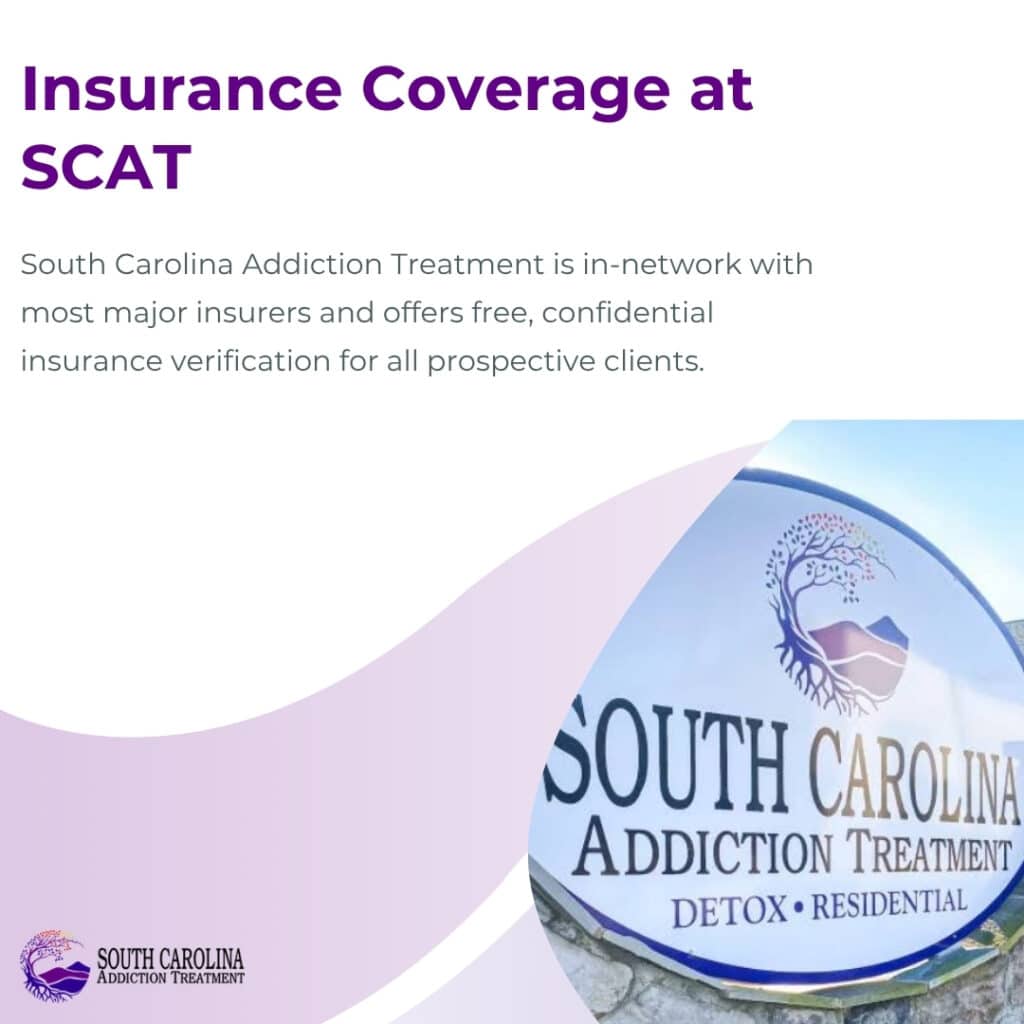
South Carolina Addiction Treatment is in-network with most major insurance providers and offers free, confidential insurance verification for all prospective clients.
Admissions Process
The SCAT admissions team handles the full verification process:
- Free verification: The admissions team contacts your insurance provider, confirms behavioral health benefits, verifies in-network status, and provides a clear breakdown of estimated out-of-pocket costs before admission.
- Same-day assessment: Once insurance is verified, clients can begin treatment the same day through the SCAT2Track program in Simpsonville, South Carolina.
- Accepted insurers: South Carolina Addiction Treatment accepts most major commercial insurers, Medicaid (for eligible individuals), TRICARE, and offers self-pay and payment plan options for uninsured clients.
"The number one barrier we hear from callers is the belief that they can't afford treatment or that their insurance won't cover it. In the majority of cases, once our admissions team verifies benefits, clients discover they have significantly more coverage than they expected. That phone call to verify insurance is the most important first step."
— Brian Banelli, Director of Admissions, South Carolina Addiction Treatment
Frequently Asked Questions
Does insurance cover drug rehab?
Most health insurance plans cover drug rehab under federal parity laws (MHPAEA) and the Affordable Care Act. Coverage typically includes medical detox, residential treatment, PHP, IOP, outpatient counseling, and medication-assisted treatment. The specific coverage level depends on your plan type, network status of the facility, and whether prior authorization is obtained.
Can a depressed person go to rehab?
Individuals with depression can and should access rehab when substance use co-occurs with depressive disorders. Dual diagnosis treatment programs address both conditions simultaneously. The ACA requires coverage of mental health services including depression treatment, and MHPAEA ensures parity with medical benefits.
Is depression covered by insurance?
All ACA-compliant health plans cover depression treatment as an Essential Health Benefit. Coverage includes outpatient therapy, psychiatric medication management, inpatient hospitalization for severe episodes, and PHP/IOP programming. MHPAEA ensures that coverage limitations for depression match those applied to medical conditions.
What are the 4 types of insurance coverage?
The four primary types of health insurance that cover rehab are employer-sponsored group plans (PPO, HMO, EPO), ACA Marketplace individual plans, government programs (Medicaid, Medicare), and military coverage (TRICARE, VA benefits). Each type covers substance abuse treatment but with different network requirements, cost-sharing structures, and authorization processes.
Does Medicaid cover rehab?
Medicaid covers substance abuse treatment in all 50 states including detox, residential treatment, outpatient counseling, and MAT. Coverage specifics vary by state. In South Carolina, Medicaid eligibility is limited to specific categories, but eligible individuals receive full behavioral health treatment coverage through enrolled providers.
How much does rehab cost with insurance?
Out-of-pocket costs for rehab with insurance vary based on your deductible (typically $500 to $5,000), coinsurance rate (typically 10 to 30% for in-network), copay amounts, and whether the facility is in-network. In-network residential treatment typically costs $1,000 to $5,000 out-of-pocket after insurance. Out-of-network costs are substantially higher.
Does insurance cover medication-assisted treatment?
Most insurance plans cover MAT medications including buprenorphine (Suboxone), naltrexone (Vivitrol), methadone (through licensed OTPs), acamprosate, and disulfiram under the pharmacy benefit. Some plans require prior authorization or step therapy. MHPAEA prohibits insurers from imposing more restrictive medication management requirements for addiction medications than for other medical conditions.
Will my employer know if I use insurance for rehab?
Employer-sponsored insurance claims are processed through the insurance company, not the employer. HIPAA (Health Insurance Portability and Accountability Act) and 42 CFR Part 2 (federal substance use disorder confidentiality regulations) protect the privacy of addiction treatment records. Your employer does not receive diagnostic or treatment details from insurance claims.
References
- U.S. Department of Health and Human Services. (2024). The Mental Health Parity and Addiction Equity Act (MHPAEA). https://www.hhs.gov/
- Centers for Medicare & Medicaid Services. (2024). Mental health and substance use disorder coverage. https://www.cms.gov/
- Substance Abuse and Mental Health Services Administration. (2024). Key substance use and mental health indicators in the United States: Results from the 2023 NSDUH. https://www.samhsa.gov/data/report/2023-nsduh-annual-national-report
- American Society of Addiction Medicine. (2023). The ASAM criteria: Treatment criteria for addictive, substance-related, and co-occurring conditions (3rd ed.).
- National Institute on Drug Abuse. (2024). Seeking drug abuse treatment: Know what to ask. https://nida.nih.gov/
- Healthcare.gov. (2024). Mental health and substance abuse coverage. https://www.healthcare.gov/coverage/mental-health-substance-abuse-coverage/
- U.S. Department of Health and Human Services. (2024). 42 CFR Part 2: Confidentiality of substance use disorder patient records.