Adderall Withdrawal: Symptoms, Timeline & Treatment
Adderall withdrawal is the cluster of physical and psychological symptoms that appears when regular use of the stimulant stops or drops sharply. Symptoms typically begin within 24 hours of the last dose.
Acute symptoms center on dysphoric mood, heavy fatigue, disrupted sleep, and increased appetite. Most resolve within two weeks, though low mood can persist longer after long-term or high-dose use.
Adderall withdrawal rarely poses a direct physical danger. The primary clinical concern is depression severe enough to require prompt professional support.
Key Highlights
- Withdrawal symptoms begin within 24 hours of the last dose, and acute symptoms last 5 days to more than 2 weeks (Shoptaw et al., 2009).
- In 2023, 1.4 percent of Americans aged 12 or older, or 3.9 million people, misused prescription stimulants in the past year (SAMHSA, 2024).
- The diagnostic hallmark is dysphoric mood plus at least two of fatigue, vivid unpleasant dreams, insomnia or hypersomnia, increased appetite, and psychomotor change.
- No medication is FDA-approved or proven effective for amphetamine withdrawal, so behavioral support carries the evidence base.
- Stimulant withdrawal is not physically dangerous the way alcohol or benzodiazepine withdrawal can be, but severe depression warrants immediate clinical attention.
Does Adderall have withdrawal symptoms?
Adderall produces documented withdrawal symptoms after prolonged use. The FDA label lists dysphoric mood, depression, fatigue, vivid unpleasant dreams, insomnia or hypersomnia, increased appetite, and psychomotor retardation or agitation following abrupt discontinuation or dose reduction.
Adderall contains mixed amphetamine salts, including dextroamphetamine sulfate and amphetamine aspartate. It is a Schedule II controlled substance because of its abuse potential.
People who take Adderall exactly as prescribed can still experience withdrawal symptoms after stopping. Their symptoms are usually milder and shorter than those reported by people who misuse high doses.
Withdrawal severity tracks closely with dose, duration, and route of use. Risk climbs among people who alter tablets, and snorting Adderall accelerates absorption in a way that deepens both tolerance and the rebound that follows.
What are the symptoms of Adderall withdrawal?
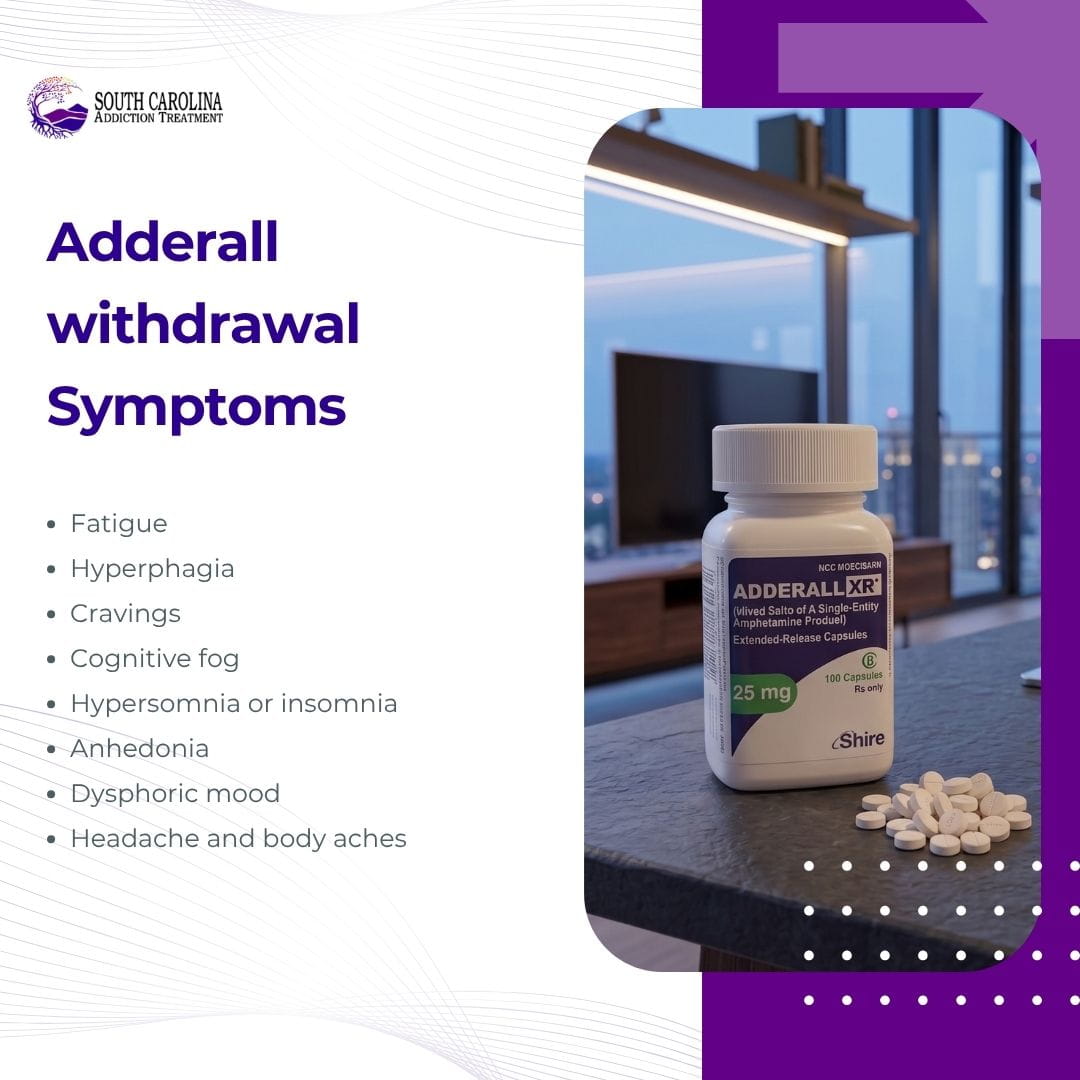
Adderall withdrawal symptoms divide into physical effects, including fatigue, hypersomnia, and hyperphagia, and psychological effects, including dysphoric mood, anhedonia, and cravings. Dysphoric mood plus two additional symptoms satisfies the DSM-5-TR threshold for stimulant withdrawal.
- Fatigue: Profound tiredness that rest does not resolve quickly. This is the most consistently reported symptom across the first week.
- Hypersomnia or insomnia: Extended sleep dominates the first 3 days as accumulated sleep debt clears. Fragmented sleep often replaces it during the second week.
- Hyperphagia: Sharp appetite increase following the suppression that occurs during active stimulant use. Weight gain during early abstinence is common.
- Headache and body aches: Diffuse discomfort reported across the first several days, usually resolving without medication.
- Psychomotor retardation or agitation: Slowed movement and speech in some people, restlessness and pacing in others. Both count toward DSM-5-TR criteria.
- Dysphoric mood: Persistent low, flat, or irritable mood. This is the core diagnostic criterion, and stimulant withdrawal cannot be diagnosed without it.
- Anhedonia: Reduced capacity to feel pleasure from ordinary activities. It frequently outlasts the physical symptoms by several weeks.
- Vivid unpleasant dreams: Intense, disturbing dreams tied to REM sleep rebound as normal sleep architecture returns.
- Cravings: Strong urges to resume use, often triggered by environmental cues such as academic deadlines or work demands.
- Cognitive fog: Impaired concentration, slowed processing, and short-term memory lapses during the first 1 to 2 weeks.
People treated for attention-deficit/hyperactivity disorder also encounter ADHD rebound symptoms. Inattention, restlessness, and impulsivity return once medication ends, and those symptoms are separate from withdrawal itself.
What does an Adderall crash feel like?
An Adderall crash is the abrupt drop in energy and mood that follows as the drug clears. Immediate-release Adderall acts for 4 to 6 hours, and Adderall XR acts for 8 to 12 hours, so the crash surfaces as coverage ends.
The crash is the opening phase of withdrawal rather than a separate condition. Users describe sudden exhaustion, intense hunger, irritability, and a flattened emotional state within hours.
Pharmacokinetics explain the timing. The d-amphetamine enantiomer has a mean elimination half-life of 10 hours and the l-amphetamine enantiomer 13 hours in adults.
Full adderall clearance takes roughly 1 to 3 days for most adults, which is why the crash gives way to a broader withdrawal syndrome.
Crash intensity scales with the preceding dose. Binge patterns, in which several doses are taken across a short window, produce the most severe crashes and the deepest early depression.
How long does Adderall withdrawal last?
Acute Adderall withdrawal lasts 5 days to more than 2 weeks. Symptoms begin within 24 hours of the last dose and peak around days 3 to 5. Low mood and anhedonia can persist for several additional weeks.
| Phase | Timeframe | Common symptoms |
| Crash onset | 6 to 24 hours after last dose | Sudden fatigue, hunger, irritability, flattened mood |
| Early acute | Days 1 to 3 | Hypersomnia, dysphoria, cravings, vivid unpleasant dreams |
| Peak | Days 3 to 5 | Strongest depression, anhedonia, poor concentration, agitation |
| Resolution | Days 5 to 7 | Sleep normalizes, appetite steadies, energy returns gradually |
| Protracted | Weeks 2 to 4 and beyond | Intermittent low mood, anhedonia, cue-triggered cravings |
Amphetamine withdrawal runs longer than cocaine withdrawal because amphetamine has a longer half-life and slower clearance.
Duration varies with several measurable factors. Higher daily doses, longer use histories, non-oral routes, and co-occurring depression or anxiety all extend the timeline.
Protracted withdrawal does not affect everyone. It appears most often in people with heavy, long-term stimulant use, and it presents as episodic low motivation rather than continuous acute symptoms.
What happens if someone stops taking Adderall cold turkey?
Stopping prescribed Adderall abruptly is generally safe and does not require a taper for most patients. Abrupt cessation after prolonged high-dose use produces extreme fatigue and mental depression, along with measurable changes on sleep EEG.
Published evidence on psychotropic discontinuation concludes that stopping prescribed stimulants is considered safe and usually does not require tapering. Symptoms are typically mild and self-limiting across roughly one week. High-dose, non-prescribed, or binge use produces a heavier crash, stronger cravings, and a higher risk of relapse during the first week.
Medical supervision is warranted in three specific situations. Those are high-dose or non-prescribed use, a history of stimulant use disorder, and co-occurring psychiatric conditions such as major depression or bipolar disorder.
Is Adderall withdrawal dangerous?
Adderall withdrawal is not physically dangerous in the way alcohol or benzodiazepine withdrawal can be. Seizures and delirium are not features of stimulant withdrawal. The risk is psychiatric, specifically severe depression and, in some cases, suicidal thinking.
The accurate warning concerns mood. Amphetamine use and withdrawal are associated with elevated rates of depressive symptoms and suicidality in systematic review evidence.
Anyone experiencing thoughts of self-harm during withdrawal should contact the 988 Suicide and Crisis Lifeline or seek emergency care immediately. That step takes priority over any plan to manage symptoms independently.
Co-occurring psychiatric conditions raise the stakes further. Depression and anxiety that predate stimulant use tend to intensify during the peak withdrawal window, and dual diagnosis addresses both conditions in parallel.
Does Medication Help With Adderall Withdrawal Symptoms?
No medication is proven effective for amphetamine withdrawal. A Cochrane review of 4 randomized trials covering 125 participants found no medication effective for the syndrome. Behavioral interventions and supportive care carry the evidence.
Contingency management holds the strongest evidence base for stimulant use disorder. The approach delivers structured incentives for verified abstinence and consistently outperforms comparison conditions in trials. Cognitive behavioral therapy addresses the thought patterns and cue exposure that drive cravings. Combining both approaches produces better retention than either alone.
Practical supports reduce symptom burden during the acute window:
- Protected sleep opportunity, since hypersomnia in the first 3 days represents genuine sleep debt
- Regular meals with adequate protein, which stabilize energy after appetite rebounds
- Hydration and light physical activity once fatigue begins lifting around day 5
- Removal of access to remaining medication supplies during the peak craving period
- Clinical evaluation for depression if low mood persists beyond 2 weeks
Supplements marketed for stimulant withdrawal, including L-tyrosine, lack randomized trial support for this indication. Prescribers should evaluate any supplement before use.
Treatment for Adderall Dependence
Most people move through stimulant withdrawal with rest, structure, and time. Professional care becomes necessary when depression turns severe, when misuse has escalated, or when a psychiatric condition sits underneath the stimulant use.
South Carolina Addiction Treatment is a CARF-accredited, family-owned facility in Simpsonville, South Carolina, serving adults. Its Track One program provides 7 days of medically supervised detox. Track Two extends care to 14 days of detox followed by residential care, giving clients a longer stabilization window before the transition home.
Clinical staff monitor mood and physical symptoms throughout stabilization, which matters most during the days 3 to 5 peak. After discharge, the team coordinates aftercare referrals to partial hospitalization, intensive outpatient, and medication-assisted treatment providers so recovery continues at a lower level of care.
Frequently Asked Questions About Adderall Withdrawal
Can dependence develop while taking Adderall exactly as prescribed?
Physical dependence can develop at therapeutic doses over months of daily use. Dependence alone is not addiction. Adderall addiction involves loss of control, escalating doses without medical direction, and continued use despite harm.
How long after stopping Adderall does normal energy return?
Physical energy typically normalizes within 5 to 7 days. Sleep and appetite stabilize across the same window. Motivation and the capacity to enjoy ordinary activities recover more slowly, often across 2 to 4 weeks. Heavy or long-term users may notice intermittent low motivation for several months. Persistent flat mood beyond 2 weeks warrants evaluation for an underlying depressive disorder.
Do withdrawal symptoms differ between Adderall IR and Adderall XR?
The symptom set is identical, but timing shifts. Immediate-release Adderall acts for 4 to 6 hours, so the crash arrives sooner and feels sharper. Extended-release Adderall acts for 8 to 12 hours, which spreads the decline across a longer window. Elimination half-lives remain the same at roughly 10 hours for d-amphetamine and 13 hours for l-amphetamine.
References
- Shoptaw, S. J., Kao, U., Heinzerling, K., & Ling, W. (2009). Treatment for amphetamine withdrawal. Cochrane Database of Systematic Reviews, 2009(2), CD003021. NIH
- U.S. Food and Drug Administration. (2023). Adderall (dextroamphetamine saccharate, amphetamine aspartate, dextroamphetamine sulfate, amphetamine sulfate) tablets prescribing information. FDA
- Patel, P., Marwaha, R., & Molla, M. (2025). Dextroamphetamine-amphetamine. StatPearls.
- McGregor, C., Srisurapanont, M., Mitchell, A., Wickes, W., & White, J. M. (2008). Symptoms and sleep patterns during inpatient treatment of methamphetamine withdrawal. NIH
- American Psychiatric Association. (2022). Diagnostic and statistical manual of mental disorders (5th ed., text rev.).