Xanax Addiction: Symptoms, Causes and Treatment
Xanax addiction is a pattern of compulsive alprazolam use that continues despite harm to health, work, or relationships. Clinicians diagnose Xanax addiction as sedative, hypnotic, or anxiolytic use disorder under the DSM-5-TR.
Xanax is addictive. The U.S. Food and Drug Administration (FDA) warns that benzodiazepines like Xanax carry risks of abuse, misuse, addiction, physical dependence, and withdrawal reactions, even at prescribed doses.
Alprazolam works fast and wears off fast. That rapid cycle of relief and returning anxiety makes Xanax more habit-forming than longer-acting benzodiazepines.
Key Highlights
- Xanax addiction is diagnosed as sedative, hypnotic, or anxiolytic use disorder, based on 11 DSM-5-TR criteria such as craving, loss of control, and continued use despite harm.
- Alprazolam reaches peak blood levels in 1 to 2 hours and has a mean half-life of about 11.2 hours, according to the FDA Xanax label.
- Physical dependence on Xanax can develop after several days to weeks of steady use, even as prescribed, according to the FDA.
- About 4.6 million people aged 12 or older misused prescription tranquilizers or sedatives in the past year, according to SAMHSA’s 2024 National Survey on Drug Use and Health.
- Benzodiazepine prescribing rates in South Carolina fell about 14% from 2020 to 2024, according to the SC Department of Public Health.
What Is Xanax Addiction?
Xanax addiction is a chronic condition in which a person keeps using alprazolam compulsively despite harmful consequences. The clinical diagnosis is sedative, hypnotic, or anxiolytic use disorder, rated mild, moderate, or severe by the number of DSM-5-TR criteria met.
Xanax is the brand name of alprazolam, a benzodiazepine prescribed for generalized anxiety disorder and panic disorder. Alprazolam is a Schedule IV controlled substance. Benzodiazepines bind to gamma-aminobutyric acid (GABA) receptors and slow brain activity, according to the FDA’s 2020 Drug Safety Communication.
The DSM-5-TR lists 11 criteria for sedative, hypnotic, or anxiolytic use disorder within a 12-month period. Meeting 2 to 3 criteria indicates a mild disorder, 4 to 5 a moderate disorder, and 6 or more a severe disorder.
Why Is Xanax So Habit-Forming?
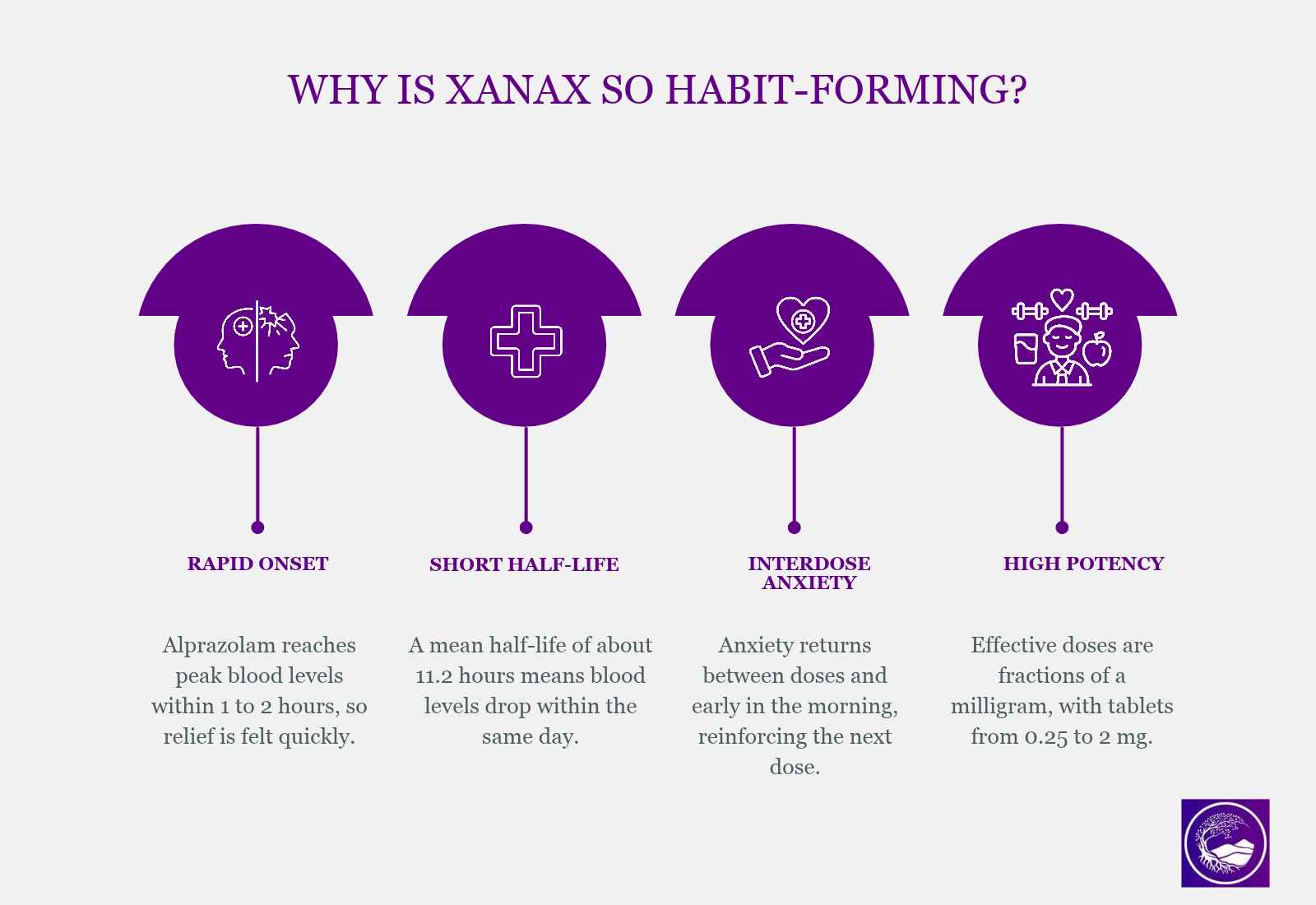
Xanax is habit-forming because alprazolam acts quickly, leaves the body quickly, and is potent at small doses. Relief arrives within 1 to 2 hours, then fades, and returning anxiety reinforces the next dose.
The following are the 4 properties that make alprazolam especially habit-forming, based on the FDA Xanax label.
- Rapid onset: Alprazolam reaches peak plasma concentration 1 to 2 hours after a dose, so relief is felt quickly.
- Short half-life: The mean elimination half-life is about 11.2 hours in healthy adults, so blood levels drop within the same day.
- Interdose anxiety: The FDA label documents early-morning anxiety and anxiety between doses in people taking maintenance doses for panic disorder.
- High potency: Effective doses are measured in fractions of a milligram, with tablets of 0.25, 0.5, 1, and 2 mg.
What Is the Difference Between Xanax Dependence and Addiction?
Xanax dependence is a physical adaptation that causes withdrawal when the drug stops. Xanax addiction is a behavioral disorder marked by craving, loss of control, and continued use despite harm. A person can be physically dependent on prescribed Xanax without having an addiction.
The DSM-5-TR does not count tolerance or withdrawal toward a use disorder diagnosis when a person takes the medication as prescribed under medical supervision. Physical dependence can occur when benzodiazepines are taken steadily for several days to weeks, even as prescribed, according to the FDA.
What Are the Signs of Xanax Addiction?
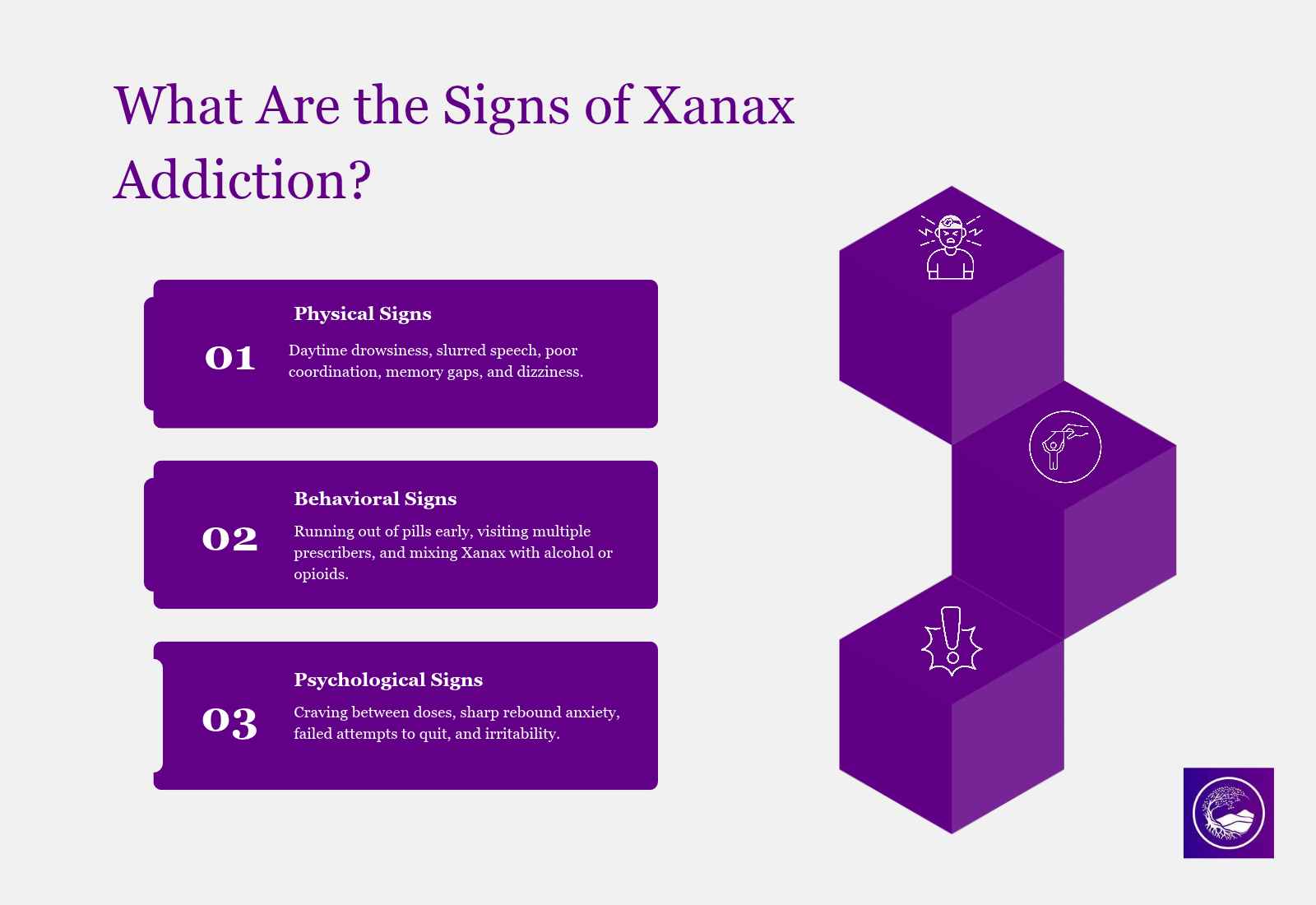
The signs of Xanax addiction fall into 3 categories: physical signs such as drowsiness and slurred speech, behavioral signs such as running out of pills early, and psychological signs such as craving and anxiety between doses.
Physical Signs
The following are 5 physical signs of Xanax misuse, based on the adverse reactions in the FDA Xanax label.
- Drowsiness during daytime hours
- Slurred speech (dysarthria)
- Poor coordination and unsteady walking
- Memory gaps for recent events
- Lightheadedness or dizziness
Behavioral Signs
The following are 5 behavioral signs that point toward Xanax use disorder, based on DSM-5-TR criteria.
- Running out of prescriptions early
- Visiting multiple prescribers or pharmacies
- Buying pills outside a pharmacy
- Neglecting work, school, or family duties
- Combining Xanax with alcohol or opioids
Psychological Signs
The following are 4 psychological signs of Xanax addiction, based on DSM-5-TR criteria and the FDA label.
- Craving for Xanax between doses
- Anxiety that returns sharply as each dose wears off
- Failed attempts to cut down or stop
- Irritability when Xanax is unavailable
Family members notice the pattern before the person does. Repeated drowsiness, missing pills, and secrecy around prescriptions are common early warning signs.
Is It Safe to Take Xanax Daily?
Daily Xanax use is safe only under a prescriber’s supervision with regular reassessment. Daily use builds physical dependence within days to weeks, and dependence risk rises at doses above 4 mg per day or after more than 12 weeks of use.
The FDA Xanax label reports greater dependence risk with doses above 4 mg per day and treatment longer than 12 weeks. Short-term use at 0.75 to 4.0 mg per day also carries some risk of dependence, according to the same label. Daily Xanax use is not automatically addiction, but it calls for periodic review of benefits and risks.
Dr. Gergana Dimitrova, MD, Medical Director at South Carolina Addiction Treatment, explains: “Daily Xanax is not a problem by itself, but daily Xanax without a plan becomes one. Every prescription should have a reason, a review date, and an exit strategy. When someone tells me they need Xanax just to get through the afternoon, that interdose anxiety is a signal to reassess, not to raise the dose.”
How Long Can You Safely Stay on Xanax?
No universal safe duration exists for Xanax, but benzodiazepines are intended for short-term use. Clinical trials support alprazolam for up to 4 months in anxiety disorder, and guidelines call for reassessment at least every 3 months.
The FDA Xanax label states that efficacy studies lasted up to 4 months for anxiety disorder and 4 to 10 weeks for panic disorder. People with panic disorder were treated on an open basis for up to 8 months without apparent loss of benefit. The British National Formulary limits benzodiazepines for severe anxiety to 2 to 4 weeks.
The 2025 Joint Clinical Practice Guideline on Benzodiazepine Tapering, led by the American Society of Addiction Medicine (ASAM), defines long-term use as regular use for more than 4 weeks. The guideline advises clinicians to reassess ongoing benzodiazepine prescribing at least every 3 months.
What Are the Long-Term Effects of Xanax?
The long-term effects of Xanax include physical dependence, tolerance, memory and concentration problems, rebound anxiety, and a higher risk of falls in older adults. Withdrawal symptoms can persist for weeks to more than 12 months after stopping.
The FDA Xanax label describes a protracted withdrawal syndrome lasting weeks to more than 12 months in some people. Memory impairment affected 33.1% of people taking Xanax in panic disorder trials, according to the same label. Older adults clear alprazolam more slowly, with a mean half-life of 16.3 hours compared with 11.2 hours in younger adults, which raises sedation and fall risk.
Is Xanax Hard to Get Off?
Yes, Xanax can be hard to get off because its short half-life produces fast-onset withdrawal and rebound anxiety. A gradual, clinician-guided taper makes stopping much safer, and stopping abruptly can cause life-threatening seizures.
The FDA Xanax label reports that seizure risk is greatest 24 to 72 hours after stopping. Seizures attributable to Xanax occurred after discontinuation or dose reduction in 8 of 1,980 patients in clinical trials. In controlled trials, 71% to 93% of people with panic disorder tapered completely off Xanax, according to the FDA label.
Tapering speed matters. The FDA label recommends decreasing the dose by no more than 0.5 mg every 3 days. The 2025 Joint Clinical Practice Guideline recommends initial reductions of 5% to 10% every 2 to 4 weeks, typically not exceeding 25% every 2 weeks. The full symptom list and timeline appear in the guide to Xanax withdrawal.
Why Is Mixing Xanax With Opioids or Alcohol So Dangerous?
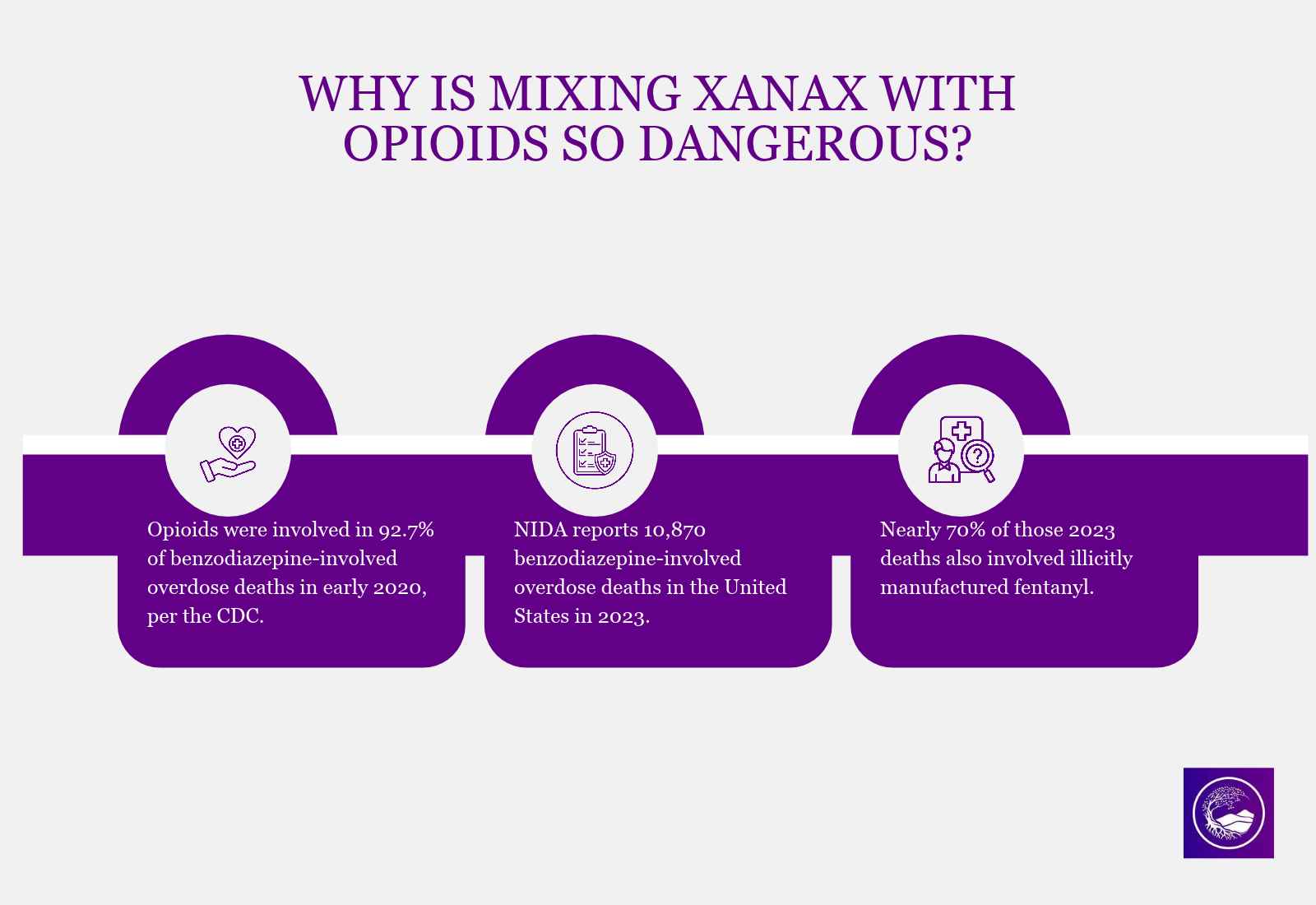
Mixing Xanax with opioids or alcohol is dangerous because each substance slows breathing. Combined use causes profound sedation, respiratory depression, coma, and death, according to the FDA boxed warning on Xanax.
The FDA added this boxed warning to benzodiazepines and opioids in 2016. Opioids were involved in 92.7% of benzodiazepine-involved overdose deaths from January to June 2020 across 23 states, according to a 2021 CDC Morbidity and Mortality Weekly Report by Liu and colleagues. NIDA reports 10,870 benzodiazepine-involved overdose deaths in 2023, with nearly 70% also involving illicitly manufactured fentanyl. Naloxone reverses opioids but does not reverse benzodiazepines. The specific risks of alcohol are covered in the dangers of mixing alcohol and Xanax.
How Common Is Xanax Misuse in South Carolina?
Alprazolam remains one of the most dispensed controlled substances in South Carolina, ranking fourth statewide in 2023. Benzodiazepine prescribing rates in South Carolina fell about 14% from 2020 to 2024, according to the SC Department of Public Health.
The SC Department of Public Health’s 2024 Prescription Monitoring Program Annual Report counted 9,402,218 controlled-substance prescriptions dispensed in 2024. Alprazolam ranked second among controlled substances prescribed by nurse practitioners in South Carolina that year.
Overdose deaths in South Carolina are declining but remain high. The SC Department of Public Health recorded 1,481 drug overdose deaths in 2024, down 31.3% from 2,157 in 2023. Greenville County recorded 178 overdose deaths in 2024. The state report does not separate benzodiazepine-involved deaths into their own category.
Treatment for Xanax Use Disorder
Recovery from Xanax use disorder starts with a supervised taper, because stopping alprazolam abruptly can trigger seizures. South Carolina Addiction Treatment, a CARF-accredited facility with 16 beds in Simpsonville, treats adults through its benzodiazepine addiction program in Greenville County.
Treatment opens with 7 days of medically supervised detox. A 14-day option extends care with a week of residential rehab that includes 3 individual counseling sessions and an optional family session. Licensed nurses run a urinalysis and the nursing intake on admission day. A psychiatric evaluation, history and physical, biopsychosocial assessment, and nursing assessment for each client are finished inside the first 24 hours.
Frequently Asked Questions Xanax Addiction
Is Xanax Addictive?
Yes, Xanax is addictive. The FDA requires a boxed warning on Xanax for abuse, misuse, addiction, physical dependence, and withdrawal reactions. Addiction risk rises with higher doses, longer use, and combining Xanax with alcohol or opioids.
Does Xanax make you irritable the next day?
Yes, Xanax can cause irritability the next day. The FDA Xanax label documents anxiety emerging between doses as alprazolam wears off. Irritability, restlessness, and rebound anxiety often appear as blood levels fall, especially in people taking Xanax daily.
Is Xanax a narcotic?
No, Xanax is not a narcotic. Xanax is a benzodiazepine and a Schedule IV controlled substance. The term narcotic refers to opioids such as oxycodone and heroin, which act on opioid receptors rather than GABA receptors.
Is generic alprazolam as addictive as Xanax?
Yes, generic alprazolam carries the same addiction risk as brand-name Xanax. Generic alprazolam contains the same active ingredient at the same strengths. The FDA boxed warning for abuse, misuse, addiction, physical dependence, and withdrawal applies to every alprazolam product.
Can a person overdose on Xanax alone?
Yes, a person can overdose on Xanax alone, although most fatal benzodiazepine overdoses involve other substances. Xanax overdose causes extreme drowsiness, confusion, impaired coordination, and slowed reflexes. The risk of death rises sharply when Xanax is combined with alcohol, opioids, or counterfeit pills containing fentanyl.
References
- Brunner, E., et al. (2025). Joint clinical practice guideline on benzodiazepine tapering: Considerations when risks outweigh benefits. Journal of General Internal Medicine, 40(12), 2814-2859. NIH
- Drug Enforcement Administration. (2025). Bromazolam: Uncontrolled benzodiazepine frequently bought from foreign websites, used in counterfeit pills (DEA Bulletin DCT-BUL-016-26).
- Lopez-Quintero, C., et al. (2011). Probability and predictors of transition from first use to dependence on nicotine, alcohol, cannabis, and cocaine. Drug and Alcohol Dependence, 115(1-2), 120-130.
- American Psychiatric Association. (2022). Diagnostic and statistical manual of mental disorders (5th ed., text rev.).
- National Institute on Drug Abuse. (n.d.). Drug overdose deaths: Facts and figures.
- Nutt, D., King, L. A., Saulsbury, W., & Blakemore, C. (2007). Development of a rational scale to assess the harm of drugs of potential misuse. The Lancet, 369(9566), 1047-1053.
- O’Donnell, J., et al. (2023). Characteristics of drug overdose deaths with evidence of counterfeit pill use. Morbidity and Mortality Weekly Report, 72(35). CDC
- South Carolina Department of Public Health. (2025). 2024 South Carolina Prescription Monitoring Program annual report. SC
- South Carolina Department of Public Health. (2026). Controlled substance scheduling order.
- Substance Abuse and Mental Health Services Administration. (2025). Key substance use and mental health indicators in the United States: Results from the 2024 National Survey on Drug Use and Health.