Adderall Overdose: Signs, Symptoms, and Treatment
An Adderall overdose occurs when the amount of amphetamine and dextroamphetamine in the body overwhelms the cardiovascular and central nervous systems. It produces a sympathomimetic toxidrome marked by racing heart rate, dangerously high blood pressure, extreme agitation, and body temperature above 104°F.
Adderall overdose is possible with prescribed doses, though risk climbs sharply with misuse, crushed or snorted pills, and combination with alcohol or other stimulants.
The U.S. Food and Drug Administration publishes no fixed lethal dose for Adderall. Individual tolerance, cardiac health, hydration, and co-ingested substances determine the threshold at which toxicity becomes life threatening.
Key Highlights
- Psychostimulant-involved overdose deaths in the United States totaled 28,722 in 2024, down from 34,855 in 2023, according to the National Center for Health Statistics.
- An estimated 3.9 million people aged 12 and older misused prescription stimulants in the past year, per the 2023 National Survey on Drug Use and Health.
- The FDA states that adult ADHD dosing rarely needs to exceed 40 mg of Adderall per day.
- No antidote reverses amphetamine toxicity. Emergency care is supportive and centers on benzodiazepines, active cooling, and IV fluids.
- Counterfeit pills sold as Adderall frequently contain fentanyl or methamphetamine, which changes both the danger and the correct emergency response.
What is an Adderall overdose?
An Adderall overdose is acute amphetamine toxicity caused by excessive stimulation of the sympathetic nervous system. Amphetamine forces the release of dopamine and norepinephrine into the synaptic space and blocks their reuptake, driving catecholamine levels far above normal.
That surge produces the clinical picture emergency physicians call the sympathomimetic toxidrome. Heart rate accelerates, blood vessels constrict, pupils dilate, sweating increases, and psychomotor agitation escalates.
Adderall contains four amphetamine salts, split roughly 3:1 between dextroamphetamine and levoamphetamine. Dextroamphetamine has an elimination half-life of 9.77 to 11 hours, while levoamphetamine ranges from 11.5 to 13.8 hours, per FDA prescribing information.
Peak plasma concentration arrives about 3 hours after an immediate-release dose. Toxicity therefore builds over hours rather than minutes, and symptoms can worsen well after the pills are swallowed.
Overdose differs from an Adderall crash. A crash reflects temporary depletion of dopamine and norepinephrine after the drug wears off. Overdose reflects excess catecholamine activity while the drug is still active.
What are the signs and symptoms of an Adderall overdose?
Adderall overdose symptoms range from restlessness and rapid heartbeat at the mild end to seizures, hyperthermia above 104°F, and cardiac arrest at the severe end. The FDA overdosage section lists tachyarrhythmias, hypertension, psychomotor agitation, hallucinations, serotonin syndrome, stroke, coma, and rhabdomyolysis. Severity tracks dose, route, tolerance, and what else was taken.
Early signs of Adderall overdose
- Rapid heartbeat and palpitations. Heart rate climbs above 100 beats per minute as circulating norepinephrine constricts blood vessels and drives cardiac output higher.
- Elevated blood pressure. Systolic readings rise well above baseline, often with a pounding headache and facial flushing.
- Restlessness and tremor. Fine hand tremor, jaw clenching, and an inability to sit still mark early psychomotor agitation.
- Severe anxiety and racing thoughts. Irritability, panic, and pressured speech appear as catecholamine levels peak.
- Dilated pupils and heavy sweating. Mydriasis and diaphoresis are hallmark autonomic signs of the sympathomimetic toxidrome.
- Nausea, vomiting, and abdominal cramping. Gastrointestinal distress accompanies appetite suppression and contributes to fluid loss.
- Insomnia and mild fever. Sleep becomes impossible while core temperature drifts upward, an early warning of thermoregulatory failure.
Severe of Adderall Overdose
- Chest pain or irregular heart rhythm. Vasospasm and tachyarrhythmia can precipitate myocardial infarction, aortic dissection, or sudden cardiac death.
- Seizures. Amphetamine lowers the seizure threshold, and convulsions signal advanced central nervous system toxicity.
- Body temperature above 104°F. Life-threatening hyperthermia impairs clotting, damages organs, and drives muscle breakdown.
- Hallucinations, paranoia, or aggressive delirium. Stimulant psychosis presents with confusion, threat perception, and combative behavior.
- Rigid muscles with dark urine. Rhabdomyolysis floods the bloodstream with myoglobin, causing acute kidney injury and electrolyte collapse.
- Stroke symptoms. Facial droop, one-sided weakness, or sudden speech loss indicate hemorrhagic or ischemic cerebrovascular events.
- Loss of consciousness or unresponsiveness. Coma follows severe hyperthermia, seizure activity, or cardiovascular collapse.
Does Adderall XR overdose present differently?
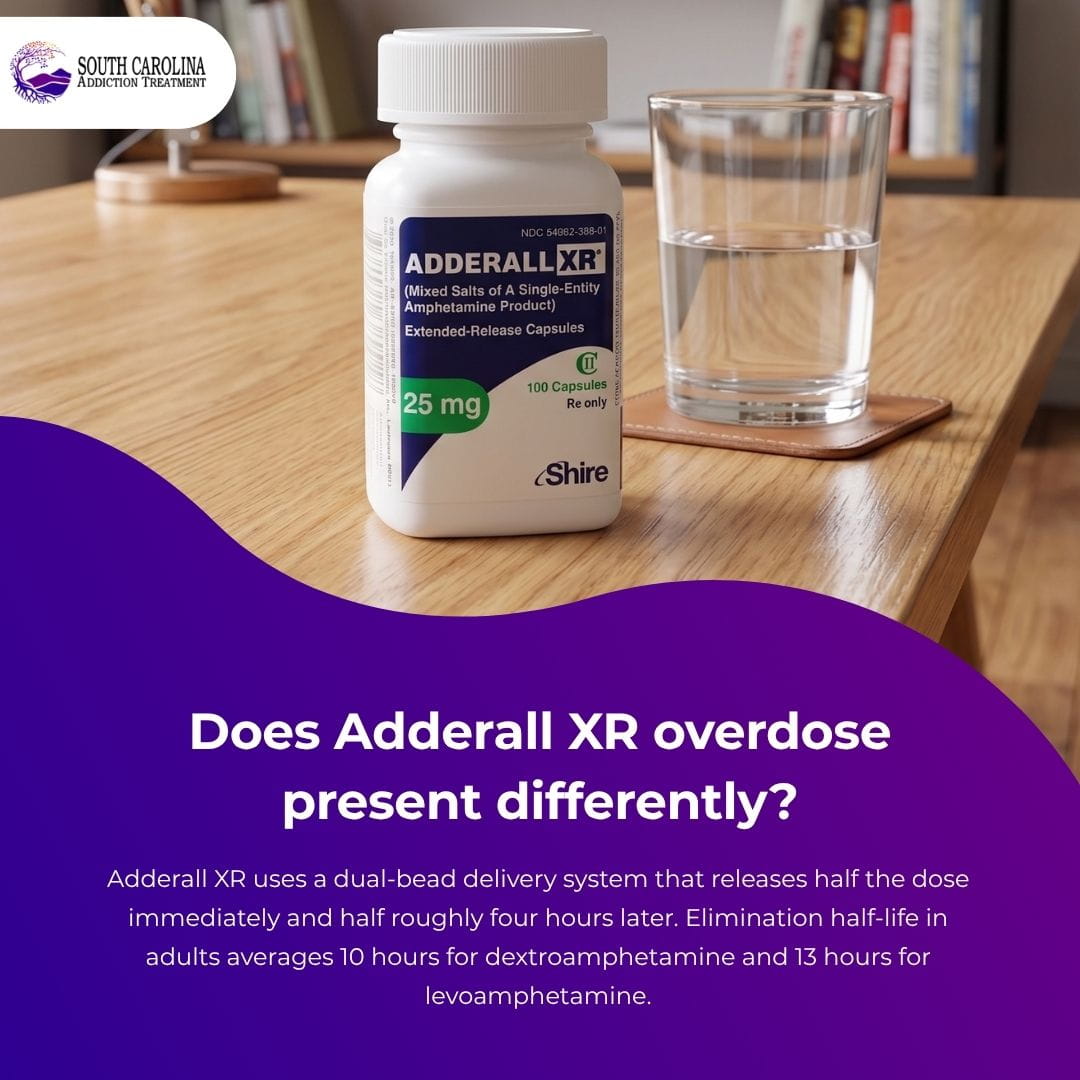
Adderall XR uses a dual-bead delivery system that releases half the dose immediately and half roughly four hours later. Elimination half-life in adults averages 10 hours for dextroamphetamine and 13 hours for levoamphetamine.
That extended profile delays peak toxicity. Someone who takes too many XR capsules may appear stable at first, then deteriorate several hours later. Emergency observation periods for XR ingestion run longer than for immediate-release tablets for that reason.
How much Adderall is too much?
No published lethal dose exists for Adderall, and the FDA label does not define an overdose threshold in milligrams. Toxicity depends on tolerance, cardiac status, body temperature, hydration, route of administration, and co-ingested drugs. The FDA-approved maximums below mark the ceiling of medical use, not a safety line.
| Formulation | Population | FDA-approved dosing |
| Adderall IR | Adults with ADHD | Titrated dose, with the label stating it will rarely be necessary to exceed 40 mg per day |
| Adderall IR | Narcolepsy | 5 mg to 60 mg per day in divided doses |
| Adderall IR | Children 6 years and older | Started at 5 mg once or twice daily and titrated |
| Adderall XR | Adults with ADHD | 20 mg once daily in the morning |
| Adderall XR | Children 6 to 12 years | Maximum of 30 mg per day |
| Adderall XR | Adolescents 13 to 17 years | 10 mg per day, increased to 20 mg where response is inadequate |
Doses at the top of these ranges belong under prescriber supervision with cardiovascular monitoring. A person taking 60 mg daily sits at the upper limit of the narcolepsy range and above the usual adult ADHD ceiling.
Route changes the calculus entirely. Crushing and snorting adderall tablets, or dissolving and injecting them, delivers the full dose to the bloodstream at once. The Adderall XR boxed warning names snorting and injection as methods that increase overdose and death risk.
Tolerance also shifts the threshold. A person taking a stable prescribed dose for two years tolerates amounts that could cause serious toxicity in someone with no exposure.
What increases the risk of an Adderall overdose?
Cardiac disease, MAOI use, dehydration, high ambient temperature, and combining Adderall with other stimulants or alcohol are the strongest amplifiers of overdose risk. Each factor either raises circulating catecholamine levels or reduces the body's capacity to compensate for them.
- Monoamine oxidase inhibitor use. MAOIs are contraindicated with amphetamines because the combination can trigger hypertensive crisis and serotonin syndrome. FDA labeling requires a 14-day washout between an MAOI and an amphetamine.
- Pre-existing cardiac disease. Structural heart disease, cardiomyopathy, arrhythmia, and uncontrolled hypertension raise the odds that stimulant strain produces a cardiac event.
- Hyperthyroidism. Excess thyroid hormone already elevates heart rate and metabolic demand, compounding the cardiovascular load amphetamine adds.
- Physical exertion in heat. Amphetamine impairs thermoregulation while suppressing thirst, so dehydration and hyperthermia develop faster during exercise, dancing, or outdoor work.
- Polysubstance stimulant use. Mixing Adderall with cocaine or methamphetamine stacks sympathomimetic load and drives most severe outcomes.
- Alcohol co-ingestion. Alcohol masks stimulant intoxication and encourages redosing, producing accidental overdose in people who feel less impaired than they are.
- Altered route of administration. Crushing and snorting tablets, or dissolving and injecting them, delivers the full dose at once and bypasses the gradual absorption oral dosing provides.
- Low or absent tolerance. A person with no recent amphetamine exposure reaches toxicity at doses a long-term prescribed patient tolerates without incident.
Can fake Adderall pills cause an overdose?
Counterfeit pills pressed to look like Adderall regularly contain fentanyl or methamphetamine rather than amphetamine salts. The Drug Enforcement Administration has issued public safety alerts specifically naming fake stimulant tablets among the counterfeits circulating through social media and online sellers.
DEA laboratory testing found that two out of every five counterfeit pills containing fentanyl carried a potentially lethal dose. The agency seized more than 9.5 million counterfeit pills in a single year during that alert period.
Fentanyl overdose produces slowed breathing, pinpoint pupils, and unresponsiveness rather than agitation and racing heart rate. Naloxone reverses opioid toxicity and should be administered when a counterfeit pill is suspected.
Naloxone does not reverse amphetamine toxicity. It is still worth giving when the substance is unknown, since it carries no harm if opioids are absent.
What should be done during an Adderall overdose?
Call 911 immediately for chest pain, seizures, confusion, unresponsiveness, or body temperature above 104°F. For milder symptoms and accidental double doses, Poison Control at 1-800-222-1222 provides free, 24-hour guidance from medical toxicology specialists..
- Stay with the person until help arrives. Symptoms can escalate within minutes, and extended-release formulations often worsen hours after ingestion.
- Move them to a cool, quiet space. Remove excess clothing and reduce stimulation, since overheating and agitation accelerate together during amphetamine toxicity.
- Offer water only if the person is alert. Never force fluids on someone drowsy, confused, or seizing, and never induce vomiting.
- Collect the ingestion details. Note the formulation, the dose, the time taken, and every other substance involved, and bring the pill bottle or packaging.
- Begin CPR if breathing stops. Start chest compressions when no pulse is detectable and continue until paramedics take over.
- Administer naloxone when a counterfeit pill is suspected. Naloxone carries no risk if opioids are absent and reverses fentanyl toxicity if a pressed tablet caused the emergency.
How common are stimulant overdose deaths?
Psychostimulant-involved overdose deaths totaled 28,722 in 2024, down from 34,855 in 2023, per NCHS Data Brief 549. The age-adjusted rate fell 19.8 percent across that single year. Total U.S. drug overdose deaths dropped from 105,007 to 79,384 over the same period.
CDC data for 2022 recorded roughly 34,000 psychostimulant-involved deaths, accounting for nearly 32 percent of all drug overdose deaths that year. The large majority of those cases also involved fentanyl or another opioid.
Fatal overdose from prescribed Adderall taken as directed is uncommon. Risk concentrates among people who misuse adderall, alter the route of administration, or combine stimulants with opioids.
Prescription stimulant misuse remains widespread. SAMHSA recorded 3.9 million people aged 12 and older misusing prescription stimulants in the past year, representing 1.4 percent of that population.
Treatment for Adderall Abuse
An overdose often reveals a pattern of stimulant misuse that has been building for months. South Carolina Addiction Treatment, a family-owned and CARF-accredited facility in Simpsonville, works with adults whose prescription stimulant use has moved beyond medical control.
Every client begins with medically supervised detox through Track One, a seven-day program with clinical monitoring around the clock. Track Two extends care to 14 days total, adding a residential treatment week that follows detox.
The facility holds 16 beds across eight rooms with a staff-to-client ratio near three to one. That structure supports close observation during the fatigue, depression, and cravings that follow heavy stimulant use.
Frequently asked questions about Adderall overdose
Does Narcan work on an Adderall overdose?
Naloxone does not reverse amphetamine toxicity because Adderall does not act on opioid receptors. Naloxone causes no harm when opioids are absent. Emergency treatment for confirmed stimulant toxicity relies on benzodiazepines, cooling, and IV fluids.
I accidentally took 40 mg of Adderall. What should I do?
A single accidental double dose at 40 mg typically produces overstimulation rather than life-threatening toxicity in someone already prescribed the medication. Do not take additional doses. Sit down, drink water, and stay in a cool room.
Is 60 mg of Adderall a lot?
Yes. 60 mg sits at the top of the FDA-approved narcolepsy range and above the usual adult ADHD ceiling, where the label states doses rarely need to exceed 40 mg daily. Taking 60 mg without supervision, or on top of an existing dose, substantially raises cardiac and psychiatric risk.
How many milligrams of Adderall is fatal?
No fatal milligram threshold is published. FDA prescribing information does not define a lethal human dose, because outcomes depend on tolerance, cardiac health, hydration, ambient temperature, route of administration, and co-ingested substances.
How long does an Adderall crash last?
An Adderall crash usually begins 4 to 6 hours after an immediate-release dose and 8 to 12 hours after Adderall XR. Most crashes resolve within several hours to roughly three days.
References
- Centers for Disease Control and Prevention. (2024). Stimulant overdose. CDC
- Drug Enforcement Administration. (2021). Sharp increase in fake prescription pills containing fentanyl and meth. DEA
- U.S. Food and Drug Administration. (2025). Adderall XR (mixed salts of a single-entity amphetamine product) prescribing information.
- Richards, J. R., & Laurin, E. G. (2024). Amphetamine toxicity. StatPearls Publishing.
- Kaye, A. D., Hamilton, K., & Vadivelu, N. (2023). Sympathomimetic toxicity. StatPearls Publishing.
- Costa, G., & Gołembiowska, K. (2022). Neurotoxicity of prescription drugs of abuse: Amphetamine-type stimulants. Frontiers in Pharmacology, 13, 926592.