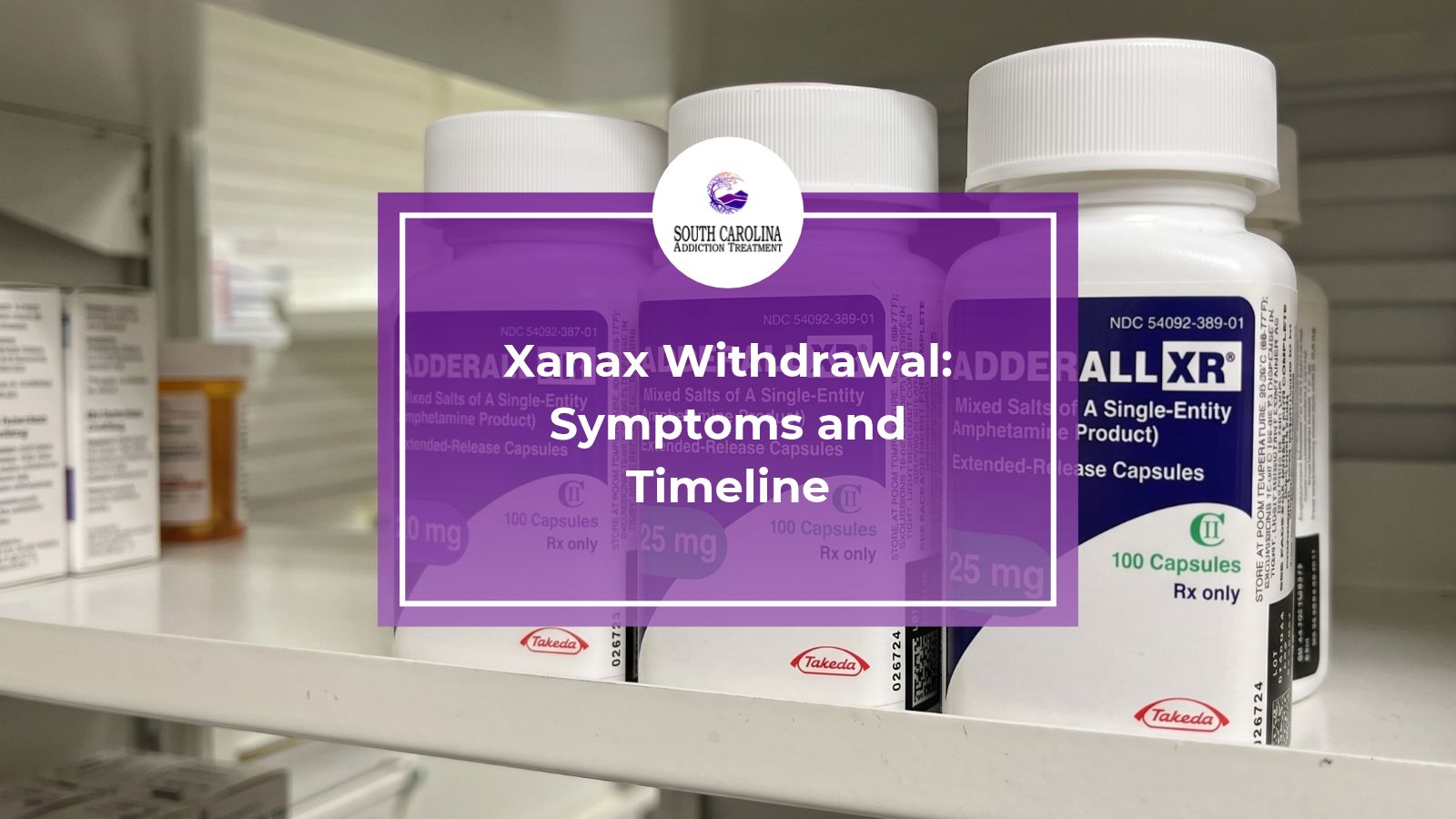
Xanax Withdrawal: Symptoms and Timeline
Xanax withdrawal is the set of physical and psychological symptoms that appear when a person who is dependent on alprazolam stops or sharply reduces the dose. Common symptoms include rebound anxiety, insomnia, irritability, muscle cramps, and heightened sensitivity to light and sound.
Seizures are the most serious risk. The FDA Xanax label reports that seizure risk is greatest 24 to 72 hours after stopping alprazolam.
Xanax withdrawal symptoms commonly begin within 6 to 24 hours of the last dose, peak in the first several days, and ease over 1 to 4 weeks. A gradual, clinician-guided taper prevents most severe reactions.
Key Highlights
- Xanax withdrawal starts quickly because alprazolam has a mean half-life of about 11.2 hours, according to the FDA Xanax label.
- Seizures followed discontinuation or dose reduction in 8 of 1,980 patients in Xanax clinical trials, and 5 of those seizures followed abrupt reductions.
- The FDA recommends reducing Xanax by no more than 0.5 mg every 3 days, and the 2025 Joint Clinical Practice Guideline recommends initial cuts of 5% to 10% every 2 to 4 weeks.
- About 1,679,000 people aged 12 or older had a tranquilizer or sedative use disorder in 2025, according to SAMHSA’s National Survey on Drug Use and Health.
- South Carolina pharmacies dispensed 9,402,218 controlled-substance prescriptions in 2024, and alprazolam ranked among the most dispensed, according to the SC Department of Public Health.
What Is Xanax Withdrawal?
Xanax withdrawal is a predictable physical reaction that occurs when a person who has developed dependence on alprazolam stops or lowers the dose. Withdrawal symptoms range from rebound anxiety and insomnia to life-threatening seizures.
Xanax is the brand name of alprazolam, a short-acting benzodiazepine prescribed for anxiety and panic disorder. Physical dependence on Xanax can develop when benzodiazepines are taken steadily for several days to weeks, even as prescribed, according to the FDA’s 2020 Drug Safety Communication.
Withdrawal is a sign of physical dependence, not proof of addiction. A person taking Xanax exactly as prescribed can experience withdrawal without having a xanax addiction.
Why Does Xanax Withdrawal Happen?
Xanax withdrawal happens because the brain adapts to alprazolam’s calming effect on GABA receptors. When the drug is removed, the nervous system becomes overexcited, which produces anxiety, insomnia, tremor, and in severe cases seizures.
Benzodiazepines enhance gamma-aminobutyric acid (GABA), the brain’s main calming neurotransmitter. With steady use, the brain reduces its own GABA response and increases excitatory signaling. Stopping Xanax removes the added calming effect before the brain readjusts, leaving the nervous system overactive.
Alprazolam’s short half-life speeds this process. The FDA Xanax label lists a mean elimination half-life of about 11.2 hours in healthy adults, with a range of 6.3 to 26.9 hours. Blood levels fall within a day, so withdrawal symptoms appear sooner than with longer-acting benzodiazepines.
What Are the Symptoms of Xanax Withdrawal?
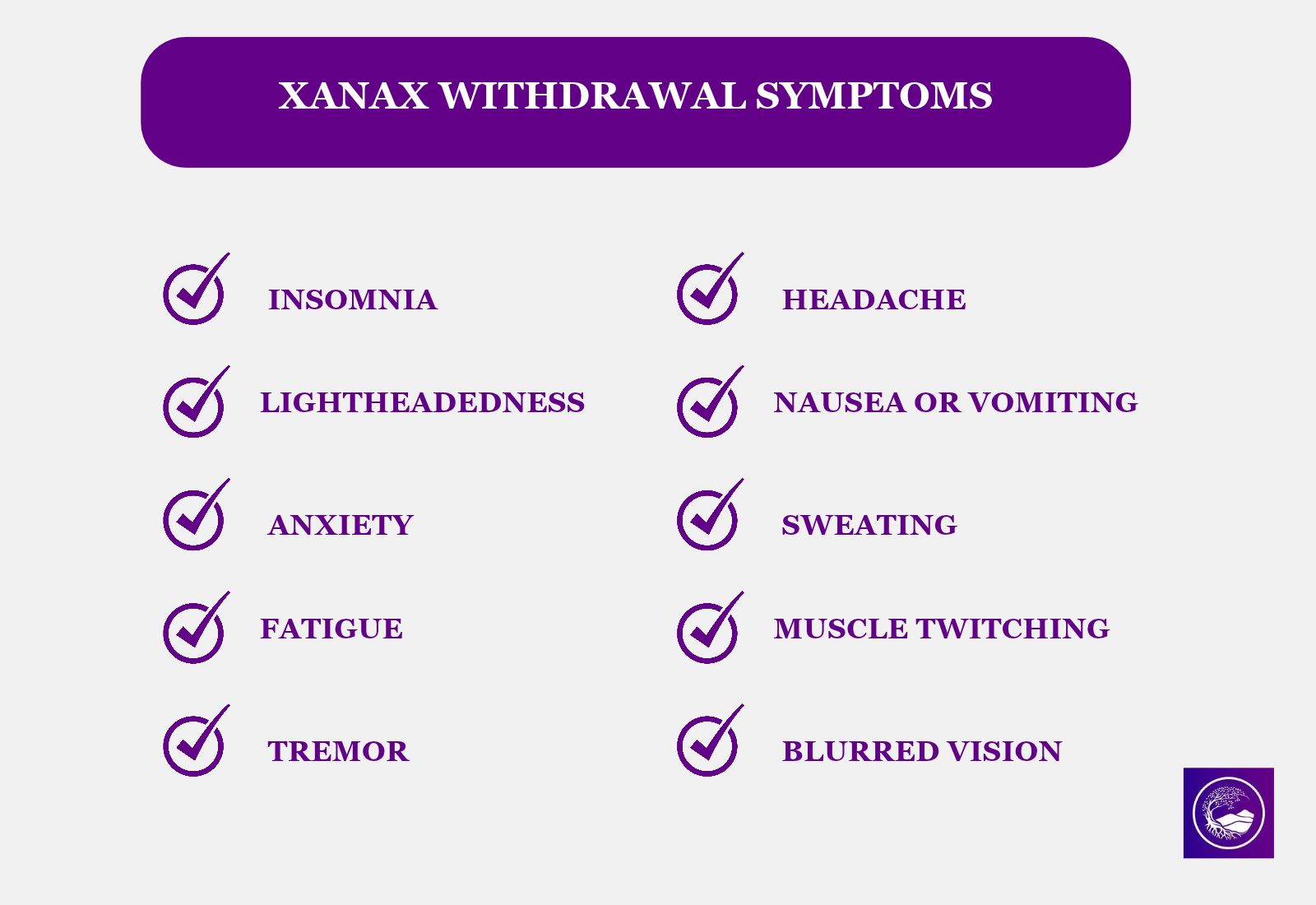
Xanax withdrawal symptoms include anxiety, insomnia, irritability, headache, nausea, sweating, rapid heart rate, muscle cramps, and blurred vision. Severe symptoms include seizures, confusion, hallucinations, and psychosis.
The FDA Xanax label reports the following 8 most common symptoms that emerged in 641 people with panic disorder after Xanax was discontinued.
- Insomnia in 29.5% of patients
- Lightheadedness in 19.3%
- Anxiety in 19.2%
- Fatigue in 18.4%
- Abnormal involuntary movement in 17.3%
- Headache in 17.0%
- Nausea or vomiting in 16.5%
- Sweating in 14.4%
The same label lists additional withdrawal symptoms observed in a controlled trial, including heightened sensory perception, impaired concentration, altered sense of smell, paresthesias (tingling), muscle twitching, diarrhea, blurred vision, decreased appetite, and weight loss.
Severe withdrawal reactions are less common but dangerous. Seizures, including status epilepticus, are the most important severe symptom, according to the FDA. Confusion, hallucinations, depersonalization, and psychosis also occur during benzodiazepine withdrawal.
What Are Rebound Anxiety and Insomnia?
Rebound anxiety and rebound insomnia are the return of anxiety or sleeplessness at a level worse than before treatment. Rebound symptoms are among the first signs of Xanax withdrawal and typically appear within the first day.
The FDA Xanax label separates 3 related experiences. Relapse is the return of the original anxiety. Rebound is the return of symptoms more intense than at baseline. Withdrawal is the appearance of new symptoms that were not part of the original condition.
What Is Interdose Withdrawal?
Interdose withdrawal is the appearance of anxiety or withdrawal symptoms between scheduled doses of Xanax, while a person is still taking the medication. Alprazolam’s short half-life causes blood levels to drop before the next dose.
How Long Does Xanax Withdrawal Last?
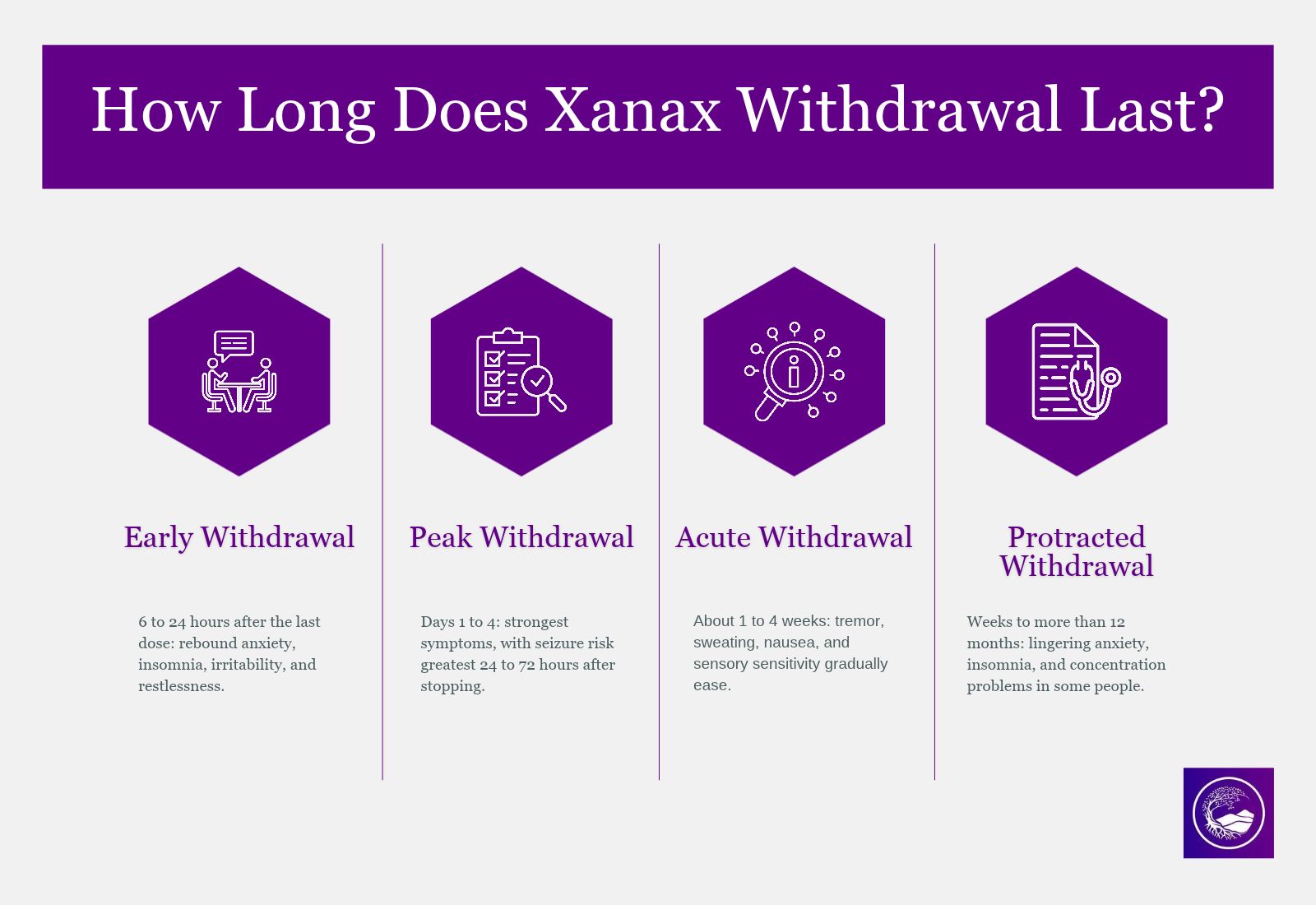
Xanax withdrawal typically lasts 1 to 4 weeks. Symptoms begin within 6 to 24 hours, seizure risk peaks 24 to 72 hours after the last dose, and some people develop protracted symptoms that last weeks to more than 12 months.
The 4 phases of Xanax withdrawal are summarized below, based on the FDA Xanax label and clinical references.
| Phase | Typical timing | What happens |
| Early withdrawal | 6 to 24 hours after the last dose | Rebound anxiety, insomnia, irritability, restlessness |
| Peak withdrawal | Days 1 to 4 | Strongest symptoms; seizure risk greatest 24 to 72 hours after stopping |
| Acute withdrawal | About 1 to 4 weeks | Gradual easing of tremor, sweating, nausea, and sensory sensitivity |
| Protracted withdrawal | Weeks to more than 12 months | Lingering anxiety, insomnia, and concentration problems in some people |
Protracted withdrawal affects a meaningful minority of long-term users. A review published in PubMed Central estimates that protracted symptoms occur in 15% to 44% of chronic benzodiazepine users. Ritvo and colleagues’ 2023 survey in PLOS ONE of 1,207 people from benzodiazepine support communities found that most reported symptoms lasting months or a year or longer.
Can You Die From Xanax Withdrawal?
Yes, Xanax withdrawal can be life-threatening. Abrupt discontinuation or rapid dose reduction can trigger seizures, including status epilepticus, a prolonged seizure that requires emergency care. The FDA describes acute benzodiazepine withdrawal reactions as potentially life-threatening.
Seizures attributable to Xanax occurred after discontinuation or dose reduction in 8 of 1,980 patients in clinical trials, according to the FDA Xanax label. Five of those seizures followed abrupt reduction from daily doses of 2 to 10 mg. One followed a taper of 1 mg every 3 days from 6 mg per day, faster than the FDA’s recommended pace. Duration of Xanax use in these cases ranged from 4 to 22 weeks.
What Makes Xanax Withdrawal More Severe?
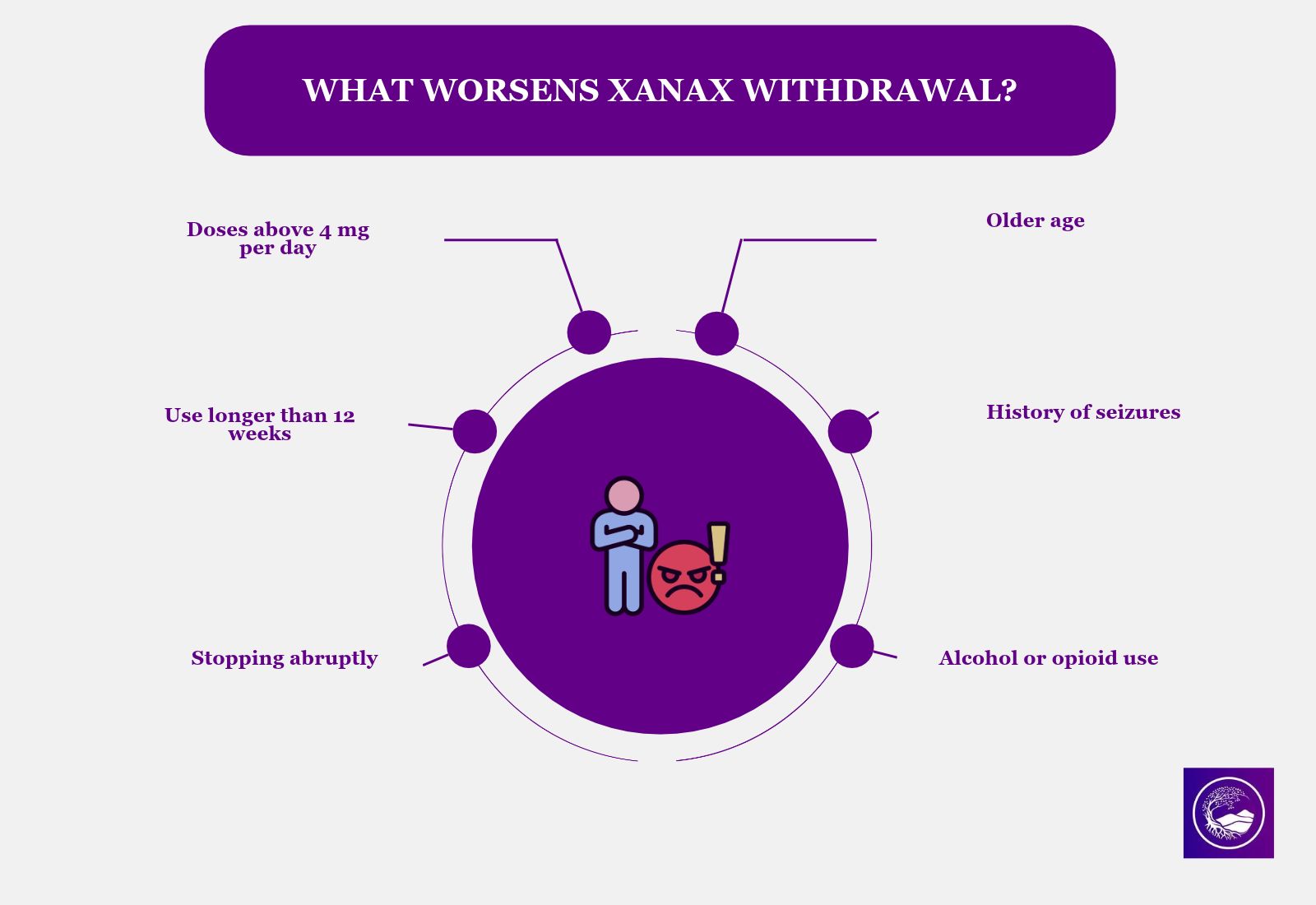
Xanax withdrawal is more severe with higher doses, longer use, abrupt stopping, older age, a history of seizures, and combined use of alcohol or opioids. The FDA reports greater dependence risk above 4 mg per day and after more than 12 weeks.
The following are the 6 factors that increase the severity of Xanax withdrawal, based on the FDA Xanax label.
- High dose: Doses above 4 mg per day increase dependence risk and make tapering to zero more difficult.
- Long duration: Use beyond 12 weeks raises the risk of dependence and withdrawal.
- Abrupt stopping: Sudden discontinuation causes most withdrawal seizures.
- Older age: Healthy older adults clear alprazolam more slowly, with a mean half-life of 16.3 hours.
- Seizure history: People with epilepsy or past seizures face a higher risk when stopping abruptly.
- Polysubstance use: Alcohol and opioids complicate withdrawal, a risk covered in the guide on the dangers of mixing alcohol and Xanax.
Why Is Stopping Xanax Cold Turkey Dangerous?
Stopping Xanax cold turkey is dangerous because abrupt discontinuation can cause seizures and other life-threatening withdrawal reactions. The FDA’s boxed warning on all benzodiazepines specifically warns against stopping suddenly or reducing the dose too quickly.
The FDA updated the boxed warning for the entire benzodiazepine class in September 2020 to cover abuse, misuse, addiction, physical dependence, and withdrawal reactions. The FDA states that stopping benzodiazepines abruptly or reducing the dosage too quickly can result in withdrawal reactions, including seizures, which can be life-threatening. Alprazolam was the most prescribed benzodiazepine in 2019, accounting for 38% of an estimated 92 million benzodiazepine prescriptions, according to the same FDA communication.
How Do Doctors Taper Off Xanax Safely?
Doctors taper Xanax by lowering the dose gradually over weeks to months. The 2025 Joint Clinical Practice Guideline recommends initial reductions of 5% to 10% every 2 to 4 weeks, typically not exceeding 25% every 2 weeks.
The FDA Xanax label sets a maximum tapering speed of no more than 0.5 mg every 3 days, and notes that some people need an even slower reduction. The label advises pausing the taper or returning to the previous dose if withdrawal symptoms develop.
The 2025 Joint Clinical Practice Guideline on Benzodiazepine Tapering, led by the American Society of Addiction Medicine with 9 partner organizations, recommends a more individualized approach. The following are the 5 core principles of a safe Xanax taper under the 2025 guideline.
- Reduce the dose by 5% to 10% every 2 to 4 weeks at the start of the taper.
- Avoid reductions faster than 25% every 2 weeks.
- Slow later reductions to 5% to 10% every 6 to 8 weeks, or slower as needed.
- Consider switching to a longer-acting benzodiazepine, such as diazepam, before tapering.
- Add cognitive behavioral therapy (CBT) or CBT for insomnia (CBT-I) to support the taper.
Rebecca Littlejohn, MSN, APRN, AGACNP-BC, APCNP-BC, PMHNP-BC, a board-certified psychiatric-mental health and acute care nurse practitioner at South Carolina Addiction Treatment, explains: “The goal of a taper is not speed, it is stability. A person who rushes the last milligram often ends up back where they started. Slow reductions, honest symptom check-ins, and permission to pause make the difference between a taper that holds and one that fails.”
When Should Someone Seek Emergency Help During Xanax Withdrawal?
The following are the 5 warning signs that require immediate medical care during Xanax withdrawal.
- Seizures or uncontrolled shaking
- Confusion or disorientation about time and place
- Hallucinations or paranoid thinking
- Chest pain or a racing, irregular heartbeat
- Suicidal thoughts or thoughts of self-harm
Treatment for Xanax Use Disorder
The safest way through Xanax withdrawal is under medical supervision, particularly for people who took high doses, used alprazolam long-term, or have had seizures before. In Simpsonville, Greenville County, South Carolina Addiction Treatment provides treatment for benzodiazepine addiction to adults in a 16-bed, CARF-accredited setting.
Withdrawal is managed during a 7-day detox program staffed with nurses around the clock. Clients who choose the 14-day path continue into a week of inpatient treatment with 3 one-on-one counseling sessions. Arrival includes a urine drug screen and nursing intake by licensed nurses, followed within a day by a biopsychosocial assessment, a nursing assessment, a psychiatric evaluation, and a history and physical.
Frequently Asked Questions
Does hydroxyzine help with Xanax withdrawal?
No medication is FDA-approved to treat benzodiazepine withdrawal. Clinicians sometimes use adjunct medications, such as hydroxyzine, to ease anxiety or sleep problems during a taper. Hydroxyzine does not prevent withdrawal seizures and does not replace a gradual benzodiazepine taper.
Can Xanax withdrawal happen after only a few weeks of use?
Yes, Xanax withdrawal can happen after a few weeks of steady use. The FDA states that physical dependence can develop after several days to weeks, even at prescribed doses. Withdrawal seizures in Xanax clinical trials occurred after as little as 4 weeks of use.
Is Xanax XR withdrawal different from regular Xanax withdrawal?
Xanax XR releases alprazolam more slowly, which smooths blood levels during treatment. Withdrawal risk remains the same, and the FDA boxed warning on benzodiazepines applies to Xanax XR. Stopping Xanax XR abruptly carries the same seizure risk as stopping immediate-release Xanax.
Can someone taper off Xanax at home?
Many people taper off Xanax as outpatients under a prescriber’s supervision with regular check-ins. Inpatient or medically monitored withdrawal is safer for people taking high doses, those with a seizure history, older adults, and people who also use alcohol or opioids.
References
- Brunner, E., et al. (2025). Joint clinical practice guideline on benzodiazepine tapering: Considerations when risks outweigh benefits. Journal of General Internal Medicine, 40(12), 2814-2859. NIH
- Busto, U. E., Sykora, K., & Sellers, E. M. (1989). A clinical scale to assess benzodiazepine withdrawal. Journal of Clinical Psychopharmacology, 9(6), 412-416.
- Conigliaro, J. (2025). Supporting patients through benzodiazepine tapering: A new joint clinical practice guideline. Journal of General Internal Medicine.
- National Institute on Drug Abuse. (n.d.). Drug overdose deaths: Facts and figures.
- National Library of Medicine. (n.d.). Utilization of adjunctive anti-seizure medications to facilitate chronic benzodiazepine discontinuation. PubMed Central.
- Ashton, C. H. (2002). Benzodiazepines: How they work and how to withdraw (The Ashton Manual).
- South Carolina Department of Public Health. (2025). 2024 South Carolina Prescription Monitoring Program annual report. SC
- South Carolina Department of Public Health. (2026). Drug overdose deaths: South Carolina, 2024.
- Substance Abuse and Mental Health Services Administration. (2026). Results from the 2025 National Survey on Drug Use and Health: Detailed tables, Section 5.
- Tyrer, P., Murphy, S., & Riley, P. (1990). The Benzodiazepine Withdrawal Symptom Questionnaire. Journal of Affective Disorders, 19(1), 53-61.